
It’s dark. It’s quiet. You’re wide awake again.
If waking up at 3am turned into your unwanted routine, you’re reading this either mid wake-up or bleary eyed the next morning after another chopped up night.
The short version?
Waking briefly around 3am is ordinary. Getting stuck awake and unable to fall back asleep is the real problem, and that second part is what you can work on starting tonight.
Key Takeaways
Your 3am wake-up lines up with normal sleep design, because the back half of the night runs heavy on light sleep.
Trouble getting back to sleep is far less common and far rougher on your next day, so falling back asleep gets top billing here.
Eight familiar patterns can trigger the same 3am stare, so match your clues before you grab a fix.
If wrecked nights drag on for weeks and bleed into your days, call a clinician instead of adding another gadget to your cart.
Why Do I Wake Up at 3am?
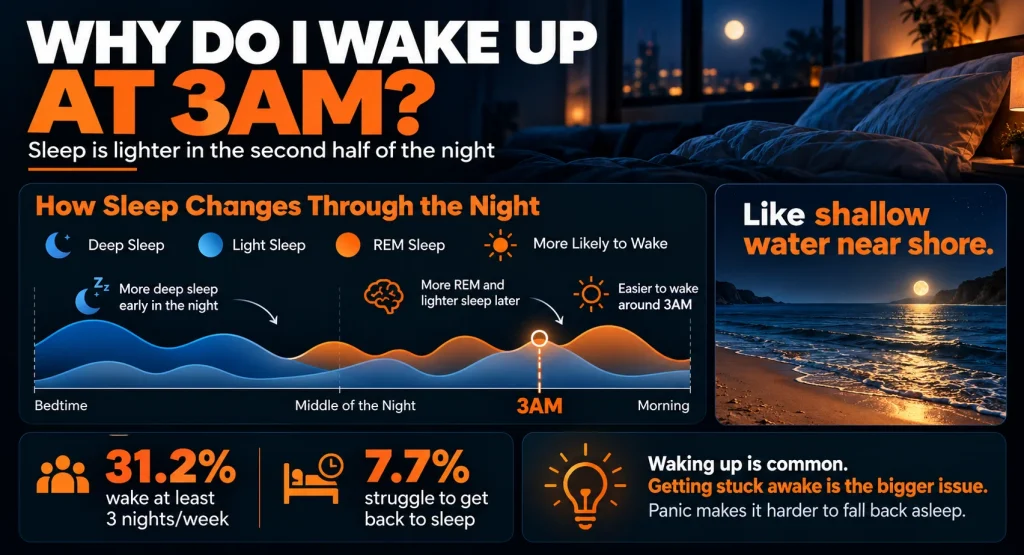
Ever wonder why your brain picks the same creepy hour to clock in? You’re waking up when sleep is easiest to break.
Sleep is not one long dive. Early night brings more deep, slow wave sleep. Late night brings more REM, the vivid dreaming stage.
Arousals are tiny shifts in brain activity. Awakenings last longer, and both dodge deep sleep and pounce out of lighter stages and REM, according to a detailed breakdown of when arousals turn into full awakenings. On a regular bedtime, the back half of the night sets this trap.
Think shallow water near shore. You’re still in the ocean, but every little ripple can lift you.
You’re in crowded company here. A large European survey tracking 22,740 adults found 31.2 percent woke at least three nights a week. Only 7.7 percent said they had difficulty resuming sleep when interviewed.
That gap is everything.
Waking is common. Getting glued to wakefulness is rarer and tougher on your daylight hours. In fact, a follow-up analysis linking failed return to sleep with next day impairment found people with difficulty resuming sleep carried several times the odds of daytime problems.
Not a free pass.
That doesn’t stamp every 3am wake-up as harmless. It means the wake itself isn’t proof your body is broken, and panic makes getting back down harder.
Which Waking Up at 3am Cause Is Related To You?
So which gremlin is stealing your sleep? Scan the table, then read only the two or three rows that sound familiar.
| If this sounds familiar | The likely lane to read first |
|---|---|
| You wake wired, heart thumping, mind already rehearsing tomorrow | Overnight stress physiology and a racing mind |
| You fall asleep fast after drinks, then pop awake later | Alcohol and REM sleep |
| You wake shaky, hungry, or after a very sugary evening | Overnight blood sugar dip |
| You wake sweaty, kick off covers, or the room feels stuffy | Bedroom heat and the late night temperature dip |
| You wake after light, sound, a phone check, or a bathroom trip with lights on | Light and noise |
| You’re in your 40s or 50s and nights changed with your cycle | Midlife hormones and menopause |
| You get up to pee most nights | Nighttime urination |
| You snore loudly and feel wrecked despite hours in bed | Possible sleep apnea, talk with a doctor |
3am wake up cortisol: rise now or alarm later?
Woke up buzzing like you chugged espresso in your sleep? Stress chemistry might be hogging the microphone, but probably not the way social media told you.
Cortisol does climb through the second half of the night as part of your normal sleep wake rhythm. Like a dimmer switch slowly brightening before sunrise, it helps tilt biology toward morning.
But that nighttime climb isn’t the cortisol awakening response. That response is its own separate surge inside the first hour after you actually get up for the day, and a review untangling overnight cortisol from the morning awakening response draws a bright line between the two.
Different timing. Different job.
The science supports timing only. It doesn’t prove a cortisol bump caused your particular wake-up, so a rough week at work isn’t a hormone diagnosis in pajamas.
If you snap awake alert, start with stress.
Alcohol and that second half of the night
Did that cozy nightcap tuck you in, then kick you out a few hours later? You fell fast because alcohol sedates, not because it soothes.
A 2025 systematic review of 27 alcohol and sleep studies in healthy adults found REM got delayed and shrunk. The hit showed up from roughly two drinks and grew worse with more.
That part is solid.
Here is where the bedtime story gets wobbly. That same review found large uncertainty for total sleep time, sleep efficiency, and wake after sleep onset. Researchers could nail down what booze does to dream sleep, but couldn’t pin down whether it reliably keeps you awake later.
Some older write-ups describe sedation first, then thin rebound sleep after. Treat that as a described pattern, not a measured certainty, and keep the review’s uncertainty in front.
If drinks are part of your evening, the move is boring on purpose. Pour less, finish earlier, and never hire a nightcap as your sleep coach.
Blood sugar: a real mechanism with narrow proof
Woke up shaky, gnawingly hungry, or sweaty for no reason? Low blood sugar can indeed yank you out of sleep, just not in the everyday way wellness posts claim.
Picture a tiny lab sleepover with IV drips and beeping monitors. In a small glucose drop experiment in 16 healthy adults, most volunteers woke during early sleep and every single one woke during late sleep once sugar was lowered. Hormonal backup against the dip also looked weaker late in the night.
That was deliberately induced low sugar in a lab, not proof your cookies caused your 3am cameo.
So keep this lane humble. Going to bed stuffed with sugar or running on fumes can both make the night bumpier. A light, balanced evening meal is the calmer middle seat.
Bedroom temperature for sleep: why heat hits hardest at 3am
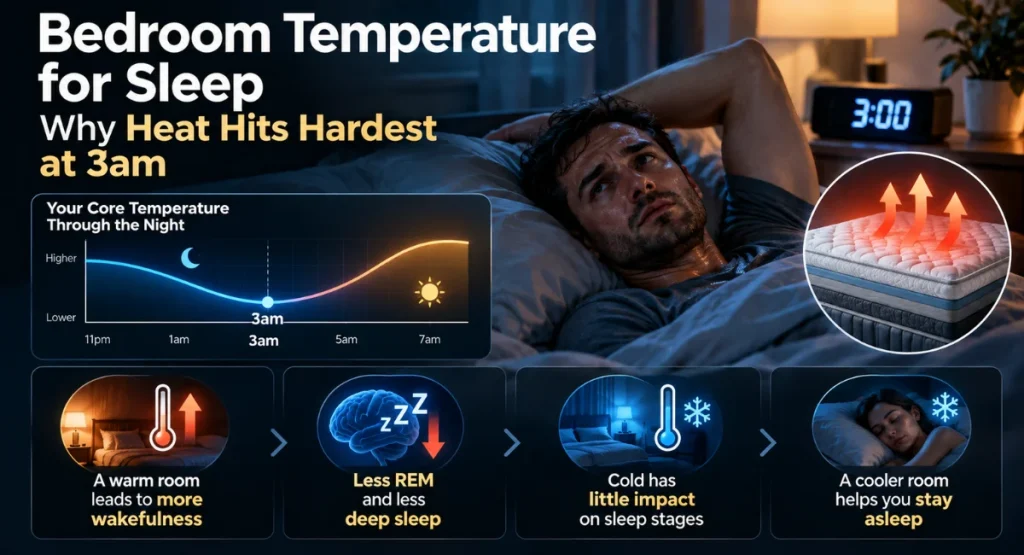
Are you flipping your pillow, then waking up damp? Your bedroom might be running a fever your body can’t ignore.
Your core temperature slides down to a late night low, then climbs toward morning to help you wake. It tracks your own wake time rather than the wall clock, and the schedule shifts a bit as you age.
That dip turns heat into a 3am specialist. A stuffy room or a mattress that traps warmth does its worst damage right when your sleep is already light.
A review of how heated bedrooms change sleep stages found more wakefulness with less REM and less deep sleep. With real bedding and pajamas in the mix, heat wrecked sleep stages while cold barely touched them.
Heat is the diva. Cold is just background music.
Body clock work adds context. A classic temperature rhythm study showing the trough follows your wake time shows the late night low point tracks your own habitual wake time, and its timing shifts with age.
If your mattress sleeps warm and you’re waking sweaty, start with the mechanism behind smart mattress temperature regulation. If you’re already suspecting the bed and don’t want a luxury price tag, browse these affordable mattresses that sleep cooler on a budget.
Light, noise, and the world’s smallest bad decisions
Did one hallway light or one buzzing phone turn into a full blown morning at midnight? In light sleep, your brain mistakes a spark for sunrise.
Light at night can ping your retina and whisper morning to a half awake brain. The blue band around 446 to 477 nanometers packed the strongest punch for melatonin suppression in overnight lab work, according to a wavelength study mapping peak melatonin suppression to short wave light.
Those flashes were tested between 2:00 and 3:30 in the morning under extra sensitive lab conditions with dilated pupils. That’s exactly when you’re tempted to light up the bathroom.
Noise pulls the same trick with your ears. A siren, a neighbor’s bass, or your partner’s late show down the hall can tip wobbly light sleep into wide awake.
Waking up With anxiety and a racing mind
Is your brain hosting a 3am staff meeting you never approved? When the world goes quiet, worries get loud.
Stress doesn’t clock out at bedtime. Deadlines, money math, parenting replays, your nervous system files them all under threat, like a smoke alarm that can’t tell burnt toast from a house fire.
That mental static leaves fingerprints on real sleep. An overnight study of 52 adults linking a buzzing mind to thinner sleep found high nighttime mental arousal went with a longer road to dozing off, choppier sleep, and fewer total hours. The pattern held for sound sleepers too, not only people with insomnia.
Weirdly comforting, right?
You don’t need a diagnosis for a busy mind to steal your night. You just need silence and darkness. A steady background hum can help when your street won’t hush, though it can’t file your worries for you.
Waking up at 3am menopause and midlife changes
Did your nights change when your cycle did? Midlife hormones can absolutely reshuffle sleep.
In a study of 168 midlife women wearing hot flash and activity monitors, wake episodes lined up with 78 percent of measured nighttime hot flashes. That held whether or not the women remembered flashing.
You can get woken by heat without ever catching the culprit, like a fridge light that turns on without you opening the door.
Hormones may matter beyond the sweat too. A smaller hormone tracking study in 45 perimenopausal women tied more awakenings to postmenopausal range estradiol and higher FSH, even after accounting for hot flashes and mood. That’s an association, not proof of cause, and not a reason to tweak hormones on your own.
Age adds its own wobble. Cleveland Clinic sleep specialists note more than half of adults over 65 report a recurring sleep problem, and they describe older sleep rhythms as more fragile.
Needing to pee: common, annoying, measurable
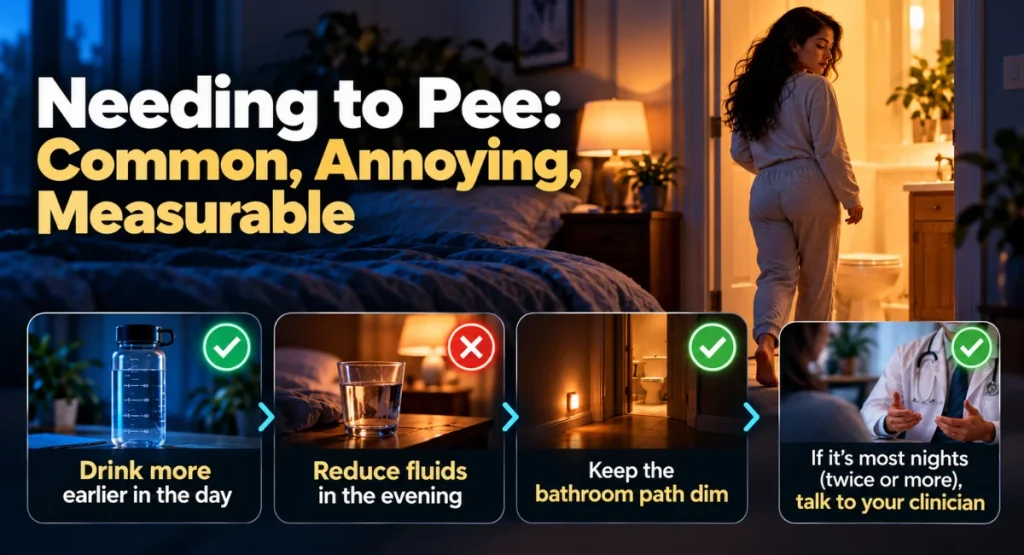
Dragging yourself to the bathroom again while half dreaming? Getting up to pee is one of the least scary causes and one of the easiest to misjudge.
Researchers still argue about how to count it, which is why numbers swing wildly. A review of 43 community surveys on nighttime bathroom trips reports wide ranges rather than one tidy stat, with younger adults spanning about one in ten to more than one in three for at least one nightly void, and older adults climbing far higher.
Forget hunting for your exact percent.
One trip after a giant bedtime water bottle is just plumbing. Repeated trips most nights, especially twice or more, earns a chat with your clinician.
Make nights easier on your bladder. Drink more earlier, taper in the evening, and keep the bathroom path dim so you don’t blast yourself into daytime mode.
Sleep apnea: the one to take to a doctor
If you snore loudly most nights and still feel flattened after a full night in bed, read this part carefully.
Breathing interruptions tend to run longer and pull oxygen lower during REM sleep. That matters because REM clusters in the back half of the night, a pattern confirmed by a review of REM sleep obstructive sleep apnea showing REM events run longer and drain oxygen more.
A 3am memory of waking isn’t the usual way this condition shows itself. The classic event is surfacing with gasping or choking.
Among people who already have obstructive sleep apnea, broken sleep is extremely common. A review reporting a meta-analysis where 42 percent of OSA patients named staying asleep as the top complaint found that fixing the breathing reduced that complaint.
Daytime sleepiness is what moves this from annoying to important. Under AASM criteria for who faces higher risk of moderate to severe OSA, higher risk means unexplained sleepiness plus at least two of three features: habitual loud snoring, witnessed pauses or gasping, or diagnosed high blood pressure.
Those nighttime signs often need a partner or housemate to spot. People who sleep alone are missed more often.
This is a medical referral, not something you fix yourself. Questionnaires and clinical tools can’t diagnose obstructive sleep apnea without sleep testing, and wrist trackers or phone apps can’t replace validated testing. If sleepiness or broken sleep persists, please see a licensed provider.
Sleep Maintenance Insomnia: When Broken Nights Become a Condition
When broken nights start charging rent on your days, the conversation changes.
Sleep maintenance insomnia means repeated trouble staying asleep, with difficulty getting back down plus fog, fatigue, or irritability that follows you into daylight.
Cleveland Clinic sleep specialists use roughly three months of symptoms as the line for a persistent problem. That’s a clinic convention, not a formal checklist you can use to label yourself.
If that sounds familiar, please don’t file it under bad habits. Ask your clinician about cognitive behavioral therapy for insomnia, usually called CBT-I.
CBT-I is considered the first line treatment for chronic insomnia in adults. The American College of Physicians recommends it as the initial treatment for all adult patients, based on moderate quality evidence, in the American College of Physicians insomnia guideline backing CBT-I first.
A second major guideline agrees. The American Academy of Sleep Medicine gives multicomponent CBT-I a strong recommendation in the American Academy of Sleep Medicine guideline giving multicomponent CBT-I a strong recommendation.
You rebuild a strong bed equals sleep link, steady your schedule, and learn to defuse unhelpful sleep thoughts, using tools like stimulus control and sleep restriction with professional guidance. Think coached training, not a tip list.
Medication is usually a later shared decision if CBT-I alone wasn’t enough. If broken nights have lasted for weeks and are ruining your days, talk with your regular clinician or a sleep specialist promptly.
How to Fall Back Asleep at 3am Tonight
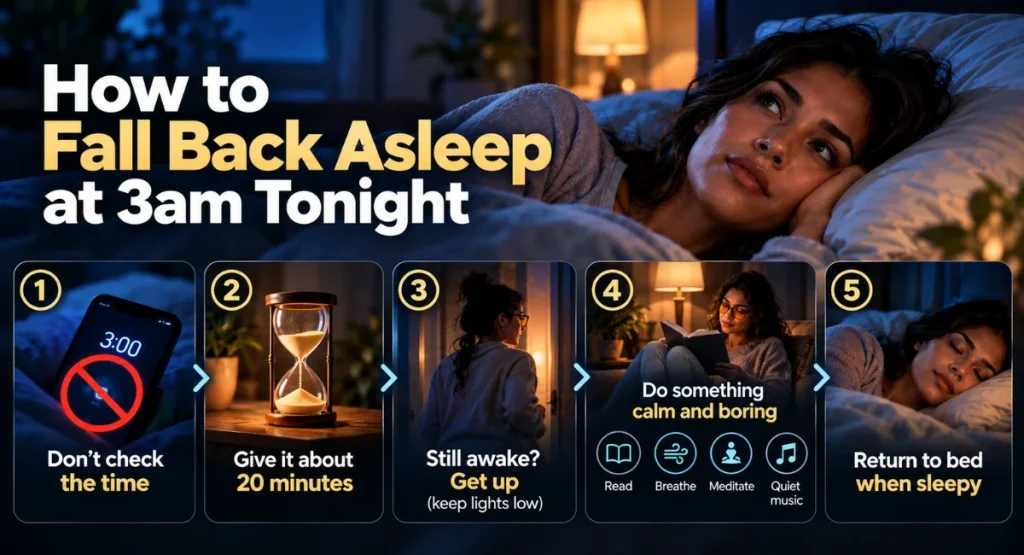
You’re wide awake with your heart thudding and tomorrow looming. That feeling can come with waking up at 3am. Tonight is about low light and low drama.
Can you resist checking what time it is? That glowing rectangle is bait. In a chart review of 1,078 sleep clinic patients on clock watching, time monitoring was common and tied to frustration about being awake, which is why sleep folks tell you to turn the clock face away.
Give yourself about twenty minutes or so. That’s not a magic number proven for 3am waking in a lab. It’s a practical rule that lines up with stimulus control, which guidelines support as one piece of insomnia care.
Still staring? Get up.
Keep lights low, do something calm and slightly boring in another spot, then crawl back only when sleepiness returns. Think paper book, slow breathing, gentle stretching, quiet music, meditation.
Your bed should feel like sleep headquarters, not a wrestling ring.
If you must get up, dodge your phone’s bright screen. Slip on blue light blocking glasses for the hallway trip and keep them on until lights out again.
For a quiet mental job to pair with slow breaths, try the step by step military sleep method for falling asleep fast.
Waking Up at 3am Spiritual Meaning
Does 3am feel like more than bad luck? Like a message or a nudge?
Sleep medicine doesn’t grade spiritual meaning. Belief lives in a different room than polysomnography, and a sleep guide can’t confirm or deny what woke your soul.
Physiology does offer a down to earth reason for the clockwork vibe. As a Cleveland Clinic sleep specialist explains, after repeated wakes for ordinary reasons like noise, stress, a baby, or bathroom trips, your body can learn the hour and start rehearsing it.
Conditioning plus light late night sleep makes a convincing ghost.
So if 3am feels eerily exact, you don’t need to fear the hour to take the pattern seriously.
What Chinese Medicine Says About Waking at 3am: Updated September 2026
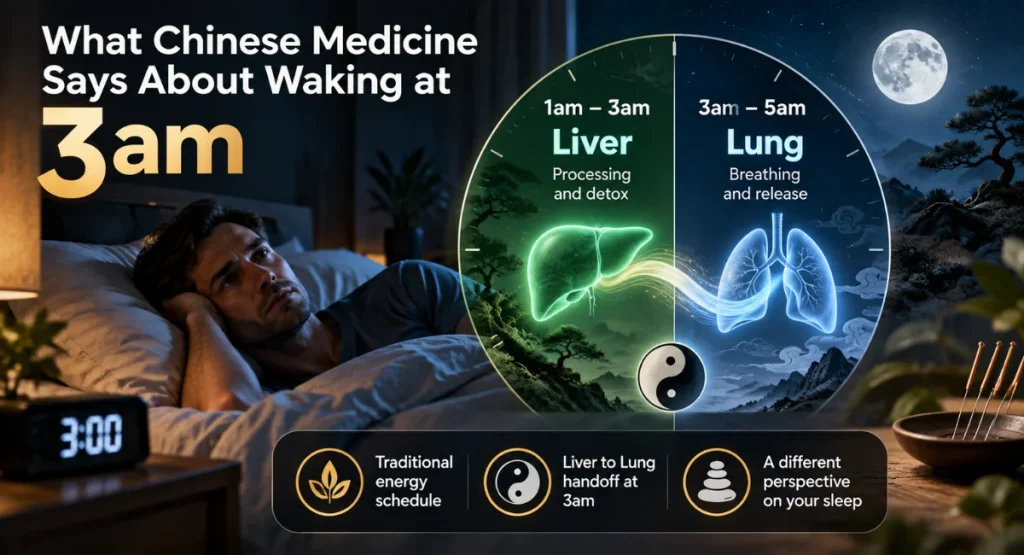
Curious why midnight internet keeps blaming your liver for 3am? That idea comes from a completely different map of the night.
Traditional Chinese medicine reads the night as an energy schedule, not as sleep stages and hormones.
The system is called Ziwu Liuzhu, often translated as midnight noon ebb flow. In this tradition, qi flows through twelve meridians in a fixed parade, spending roughly two hours at peak in each channel.
What the tradition holds is that Liver holds 1 to 3am, then passes the baton to Lung for 3 to 5am. So a 3am wake lands right on the Liver to Lung handoff.
Still, that image isn’t a body mechanism, and it shouldn’t sit on the same shelf as REM science or cortisol timing.
Acupuncture comes up next for many readers, so here is the careful version. The best available review, a 2012 Cochrane review of 33 trials in 2,293 people with insomnia, saw some encouraging signals but called the evidence “not sufficiently rigorous to support or refute” acupuncture for insomnia, because trials were weak and publication bias looked likely. Reported harms were rare and minor, and an updated Cochrane review is now underway.
If this framework matters to you, use it as a lens for reflection. Talk with qualified practitioners and your own clinician about what fits your care.
Preventing the Next 3am Wake-Up
Ready to make tomorrow night kinder? Fix the lane that matched your table, not all eight at once.
Wear blue light blocking glasses for an hour before bed
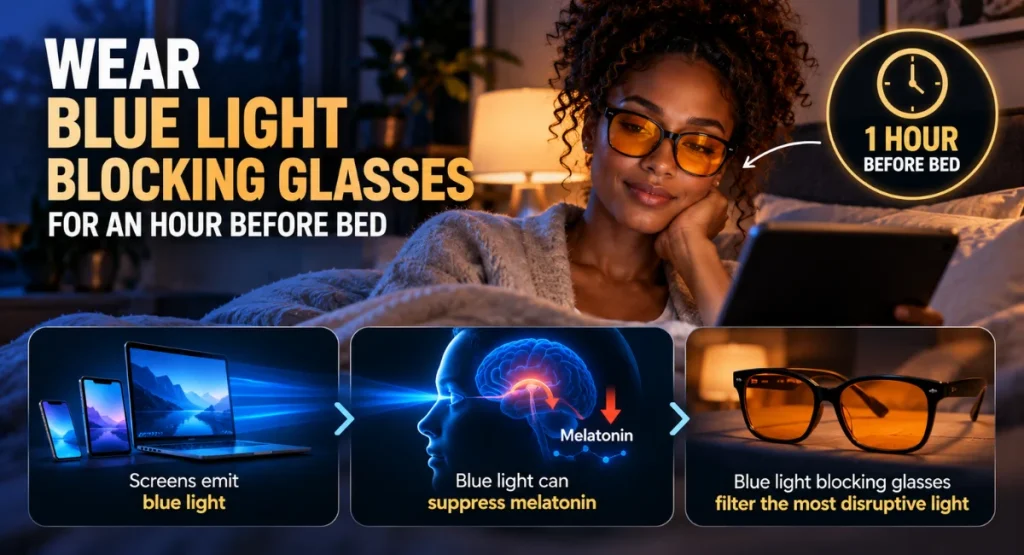
These are amber tinted evening glasses. You pop them on about an hour before bed and just carry on with your night.
Your screens and bright overhead bulbs tell your brain it is still daytime. It is that short wave blue and green light that your melatonin reacts to most.
You do not have to sit in the dark to sleep well. Finish the episode. Scroll for twenty minutes. Cook under the kitchen spotlights while the lens does the filtering so the evening stays yours.
A cleaner wind down like that gives you less working against you in those light hours of the back half of the night. That is right where 3am trouble lives.
And you will actually wear them because they look good. That amber lens is the Robert Downey Jr, Iron Man look, not a medical device. You can answer the door in them.
Keep them by your bed too. If you get up at 3am, keep them on for the hallway trip so the bathroom light does not undo the evening.
Cheap pairs are a false economy. Many are clear or pale yellow and barely touch the range that matters, and the hinges go fast so they look and feel cheap.
And you cannot check them for yourself. That little LED pen that ships with a lot of pairs proves nothing, because it peaks near 400nm violet rather than what your screen actually puts out. So you are trusting whoever made them, which is the whole argument for buying from someone who publishes their own testing.
This is where I get mine. I have the Hudson and they are still solid after five years of daily use. There are plenty of frames and styles to choose from, eighteen in the one unisex collection.
See the BON CHARGE evening glasses here
Swap the evening screen for red light
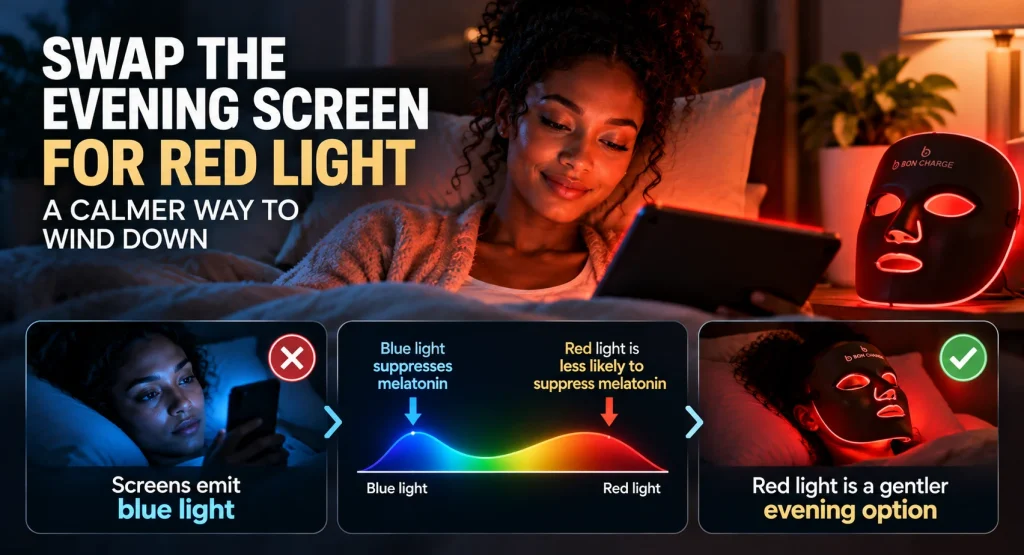
This is a soft, flexible mask you wear for about ten minutes in the evening. It is red light with no blue, so you are not getting that daytime signal.
The best part is what it gives you to do. Sticking to a wind down is tough because it is boring, so you reach for your phone. With this you are lying still, occupied, and you are not getting blue light thrown in your face.
It is a low blue way to spend that time. A phone is not.
It is sold as a skin device and that is really the point of it. So if you want that side too, you are getting two things out of the same ten minutes.
It is flexible silicone that sits on your face rather than hovering off it. It comes with eye cups too, so you can close your eyes and just rest.
Cheap masks get this wrong. A lot of cheap LED masks add blue or white diodes, which is exactly backwards for evening use. Most are rigid shells that do not follow your face, with no published output figures so you have no way to know what you are getting.
One thing to be clear on before you look. This is a beauty device, not a sleep treatment, and BON CHARGE makes no sleep claims for it themselves. The sleep evidence for red light is thin, a small 20 athlete study with no sham arm and no awakening outcome, so it will not fix 3am waking.
It could be a fit if you want an evening ritual that is not a screen, or if you want the skin side anyway. You are swapping ten minutes of phone light for ten minutes of stillness.
See the BON CHARGE red light mask here
Cool the bedroom
Is your bed cozy at 11pm and stifling by 3am? Late night is when trapped heat bites hardest.
Think cave conditions. Dark, quiet, slightly cool, with bedding you don’t have to fight.
If your mattress wakes you sweaty, improve airflow and lighten covers first, then consider a budget friendly replacement that sleeps cooler if the problem persists.
Move the last drink earlier
Love a glass to unwind, then pay for it at 3am? Alcohol grades its own homework kindly.
The 2025 review of 27 studies found REM harm from roughly two drinks upward, but large uncertainty for total sleep time, sleep efficiency, and wake after sleep onset. That’s a shrug, not proof alcohol leaves your continuity alone.
Earlier and lighter is the whole trick. No nightcap heroics.
For tidy caffeine and alcohol cutoffs without memorizing a textbook, use the 10-3-2-1-0 sleep timing rule.
Keep a consistent wake time and a real wind-down
Does your wake time swing on weekends? Your body clock loves routine.
Anchor the morning. Same wake time daily, bright light soon after, movement during the day, then a real wind down.
The behavioral guideline for chronic insomnia favors structured care over lone habit tweaks. For the wider routine behind those habits, see the complete guide to how to optimize your sleep.
Small, repeated, boring. That’s how rhythms learn.
Use a white noise machine if your house or street is not quiet
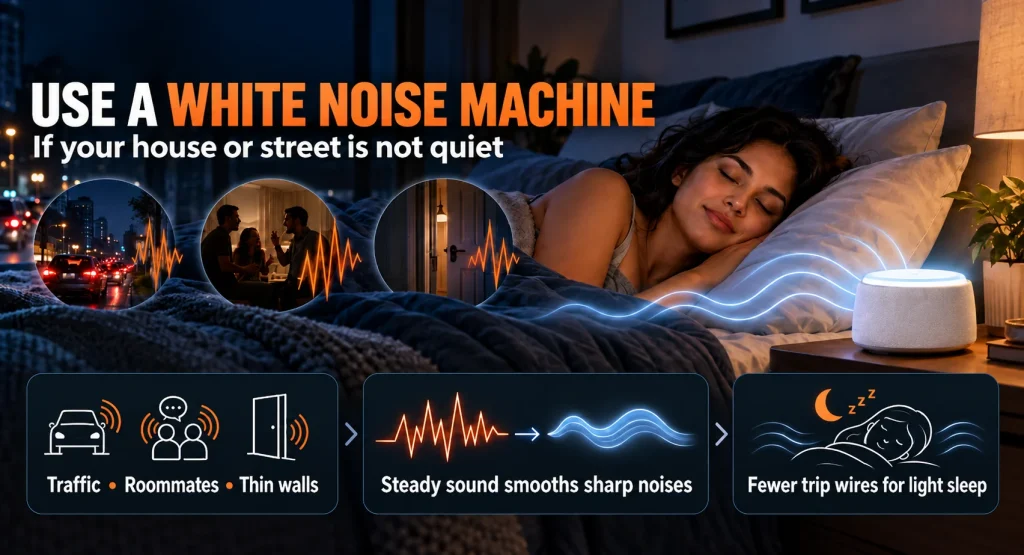
This is a little machine that makes steady sound so sharp noises never quite reach you. You turn it on and let it run under everything else.
The win is what you get to stop doing. You stop lying there braced for the next car door, the next creak, the next neighbor. In the back half of the night your sleep is light and every sharp edge can pull you up.
Steady sound smooths those edges into one flat background. And you get to keep your setup. You do not have to move, replace the windows, or negotiate with anyone you live with.
For 3am, the fan part matters. A real spinning fan cannot loop. A recorded file restarts, and a half awake brain catches that gap. There is no gap to catch in a fan.
It handles noise, not worry. It will not quiet a racing mind, but it will take the street and the house out of the mix.
Phone apps and cheap machines usually play a loop, and the loop is what wakes you. The speakers can sound tinny, more like static than air, and plenty do not survive a year of nightly use.
YogaSleep make the fan based Dohm, in production since 1962, alongside digital models. Go fan if you sleep in one place and your street is noisy, go digital if you travel a lot or want it to switch itself off.
Compare the YogaSleep models here
Waking Up in The Night at 3am FAQs
Is waking up at 3am every night normal?
Brief wakes are common, especially in that light late night sleep. It earns attention when it stretches for weeks, you can’t get back down, and your days fill with fatigue, brain fog, or a short fuse.
Why do I wake up at the same time every night?
Your sleep cycles run the same nightly loop, so the same fragile window can reopen. Conditioning can cement it after repeated wakes for another reason, such as noise or bathroom trips.
How can I fall back asleep quickly?
Skip the clock check, keep lights low and boring, try slow breathing or quiet reading, and get out of bed after about twenty minutes if sleep stays missing. Head back only when drowsy returns.
Does a sugary bedtime snack cause 3am wakes?
No direct proof ties a sugary snack to 3am wakes in healthy people. Lab work shows low glucose can wake sleepers and that late night defenses are weaker, but that’s not proof your dessert dialed your wake-up.
When should I talk with a doctor?
If broken nights persist for weeks and cost you your days, or if loud snoring with pauses or gasping has been noticed, get medical input soon. Bring your sleep pattern and daytime symptoms, not just your worry.
Your Next Move Tonight
Pick one lane from the table, not all eight.
If heat woke you, cool the room and lighten the covers. If your mind woke you, hide the clock and take a boring reset after about twenty minutes. If broken nights have lasted for weeks and stolen your days, book the clinician visit first.
You’re not broken just because you’re waking up at 3am. You’re just awake, and now you’ve got a plan for getting back down.