
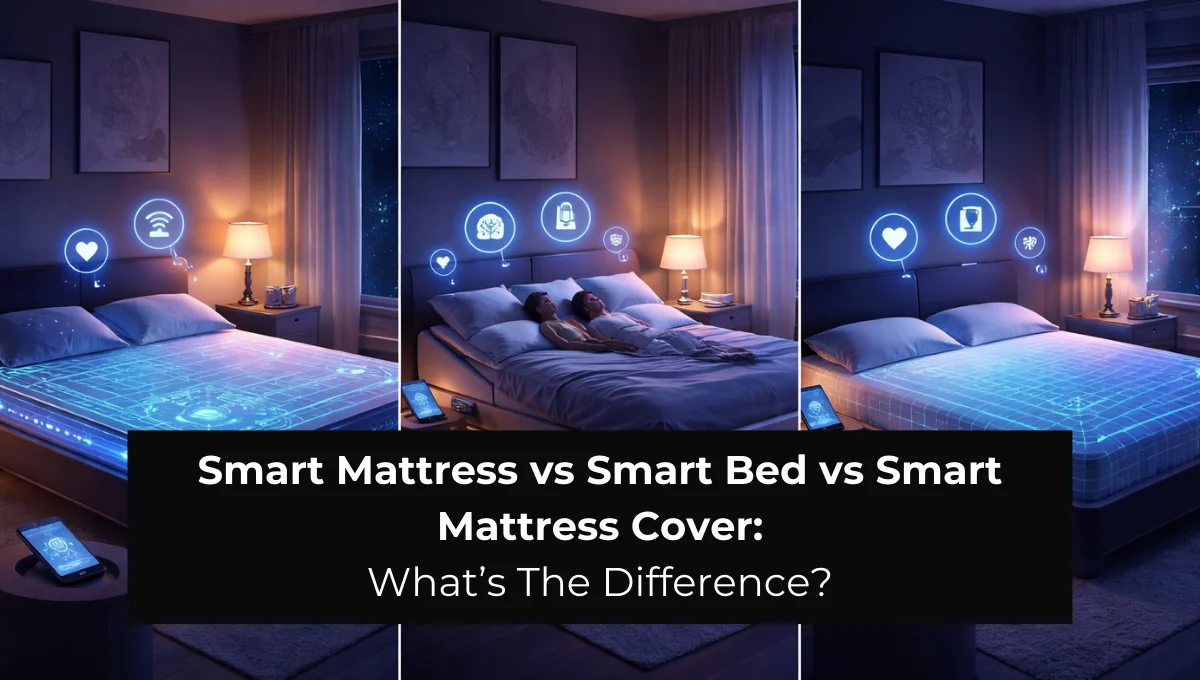
Here’s the thing about shopping for a smart mattress vs smart bed vs smart mattress covers – the terms get thrown around so loosely that they’ve almost lost their meaning.
Some products are full-on mattresses with technology built right into them.
Others are traditional mattresses paired with high-tech adjustable bases that handle all the “smart” features.
And then there are smart mattress covers that simply layer on top of the mattress you already own.
They all promise better sleep.
They all come with apps.
And they all cost a serious amount of money.
But here’s what actually matters: they work in very different ways, solve very different sleep problems, and come with very different trade-offs.
If you don’t understand which category you’re really looking at, it’s easy to spend a thousand dollars—or a lot more—on something that doesn’t address your real issue.
So let’s break down what a smart mattress, a smart bed system, and a smart mattress cover actually are, what each one does well, and who should realistically consider each option.
Why Smart Mattress vs Smart Bed vs Smart Mattress Covers Cause Confusion
The mess starts with how these products get marketed.
Brands love using “smart bed” as a catch-all term, even when they’re selling completely different things. Review sites do it too. Retailers definitely do it. So you end up with three totally separate product categories all wearing the same label.
Here’s what’s actually out there:
- True smart mattresses with technology built into the mattress itself
- Regular mattresses paired with high-tech adjustable bases that do the smart work
- Tech-enabled covers that retrofit onto a bed you already have
Because they all offer sleep tracking and app control, they look pretty similar at first glance. The differences show up later—when you’re trying to move it, fix it, upgrade it, or pay for it over time.
Without knowing what category you’re buying into, it’s really easy to end up with a product that misses the mark entirely.
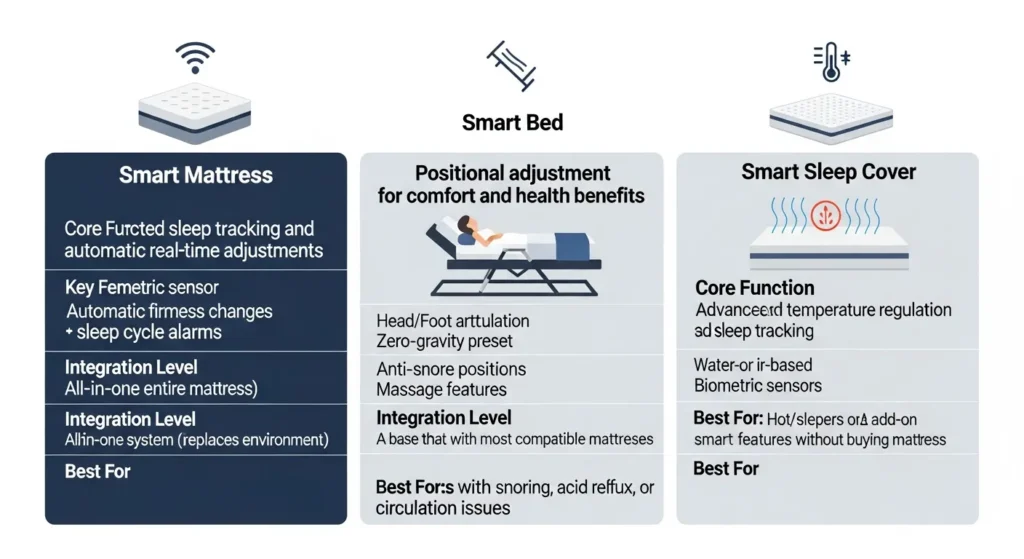
What Is a Smart Mattress?
Smart Mattress Definition
A smart mattress puts the technology directly inside the mattress structure itself.
The tech is usually designed to adjust how firm or soft the bed feels, change support levels in different zones, and track your sleep patterns.
Everything happens within the mattress—not in a base underneath it or a cover on top of it.
How Smart Mattresses Work
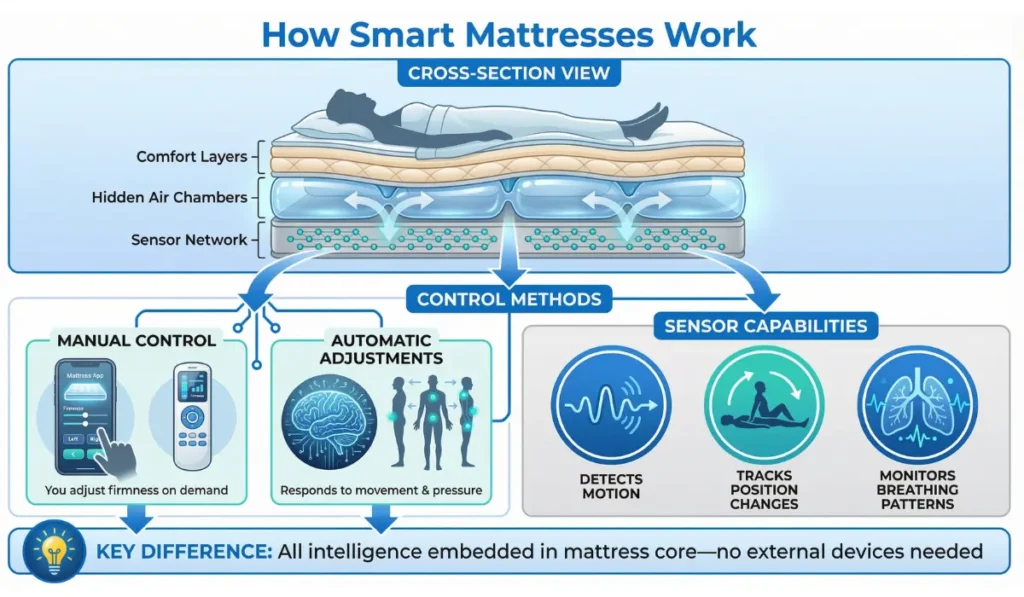
Most smart mattresses use air chambers hidden beneath the comfort layers you actually sleep on. These chambers inflate or deflate to change firmness, which you can control manually through a remote or app. Some models adjust automatically based on how you’re moving or where pressure is building up.
Sensors embedded throughout the mattress detect motion, position changes, and sometimes even your breathing patterns.
The key difference? All the intelligence lives in the mattress core. You’re not relying on anything else to make it “smart.”
Smart Mattress Pros
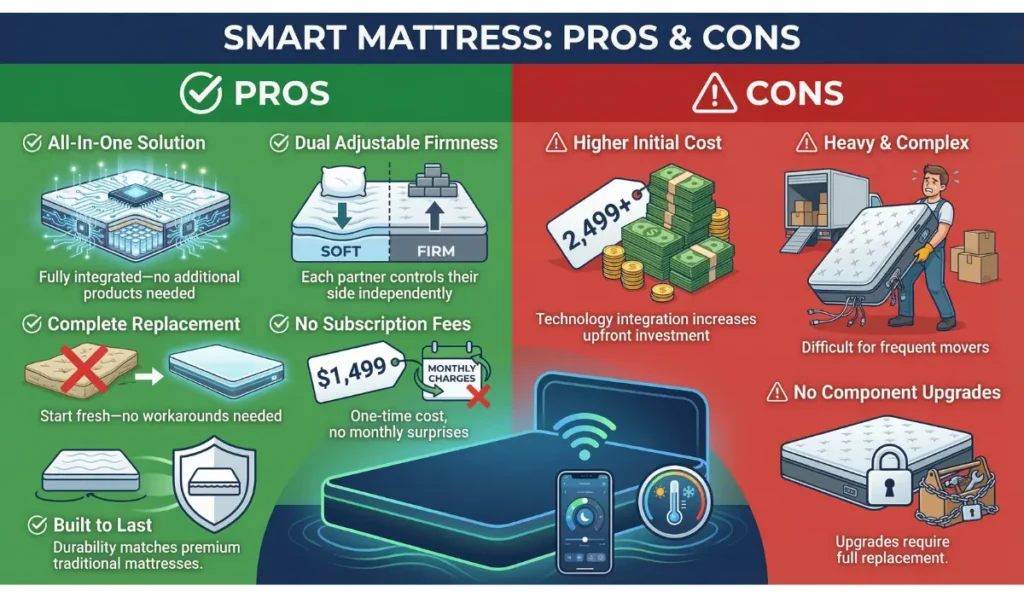
You get a fully integrated solution that doesn’t depend on other products to work. That means one less thing to coordinate during setup or worry about down the line.
The adjustable firmness is genuinely useful, especially if you and your partner want different levels of support. Most smart mattresses let each side dial in their own preference independently.
Since this replaces your entire mattress, you’re not stuck working around whatever bed you currently have. You start fresh with exactly what you need.
Subscriptions are rare with smart mattresses, which means the cost you see upfront is pretty much what you’ll pay. No surprise monthly fees a year later when you want to keep using features you already paid for.
These are built to last as full mattress replacements, with durability that matches (or exceeds) traditional high-end mattresses.
Smart Mattress Cons
The upfront cost runs higher than a standard mattress. You’re paying for the technology integration, and that adds up.
They’re heavier and more complex to move. If you relocate often, this is worth considering.
You can’t really upgrade individual components later. If you want better temperature control or a different type of sleep tracking, you’d need to replace the whole thing.
Who Are Smart Mattresses Best For
Couples who can’t agree on firmness will love the dual-sided adjustability. No more compromise sleeping.
If your comfort needs shift over time—whether from injury, weight changes, or just preference—being able to adjust firmness on demand is incredibly valuable.
People dealing with back pain or pressure-point sensitivity may benefit from the ability to fine-tune support exactly where they need it.
Buyers who want long-term customization without getting locked into subscription fees should strongly consider this option.
Smart Mattress Example Brands
- Sleep Number
- Bryte Balance
- Saatva Solaire
For more brands, see our top rated smart mattresses.
What Is a Smart Bed System?
Mattress + Smart Base Explained
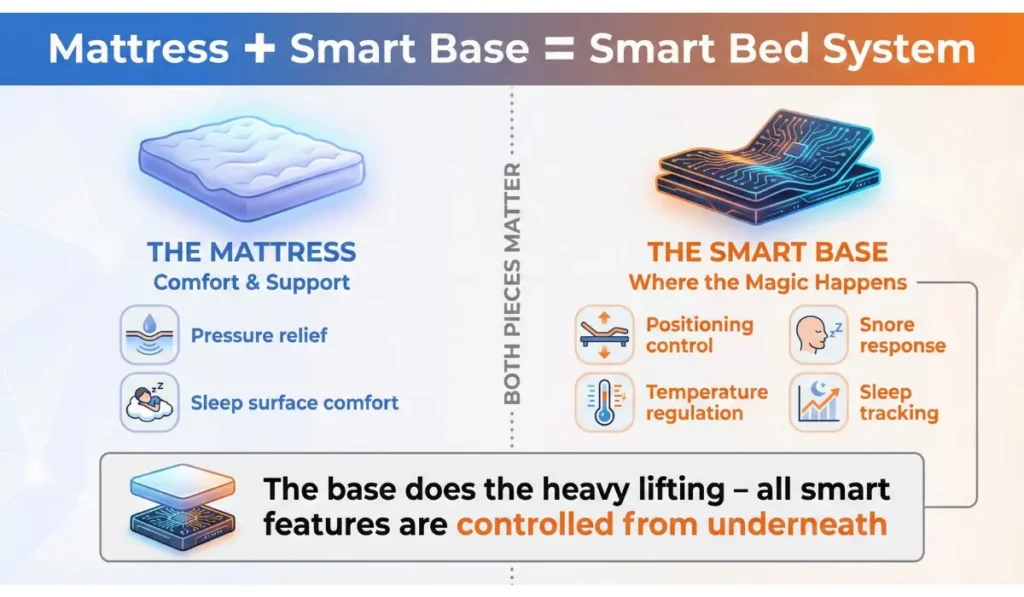
A smart bed system pairs a mattress with a seriously advanced adjustable base.
In these setups, the base does most of the heavy lifting when it comes to smart features. We’re talking positioning, snore response, temperature regulation, and sleep tracking—all controlled from the base underneath.
The mattress focuses on what mattresses do best: comfort and pressure relief. The base handles movement and automation.
It’s a two-part solution where both pieces matter, but the base is where the magic really happens.
Smart Bed System Key Features
These systems can elevate your head and feet independently, letting you find a sleep style and positions that actually relieve pressure and discomfort.
Zero-gravity positioning mimics the posture astronauts use to reduce strain on the body. It sounds gimmicky until you try it.
Snore detection is legitimately helpful—the base automatically lifts your head slightly when it picks up snoring sounds, which can open airways without waking you up.
Lumbar support adjustments let you dial in lower back support precisely where you need it.
Sleep tracking happens through sensors built into the base, monitoring your movement patterns and sleep stages throughout the night.
Some systems include active temperature ranges using airflow channels that push cool or warm air through the mattress layers.
Smart Bed Pros
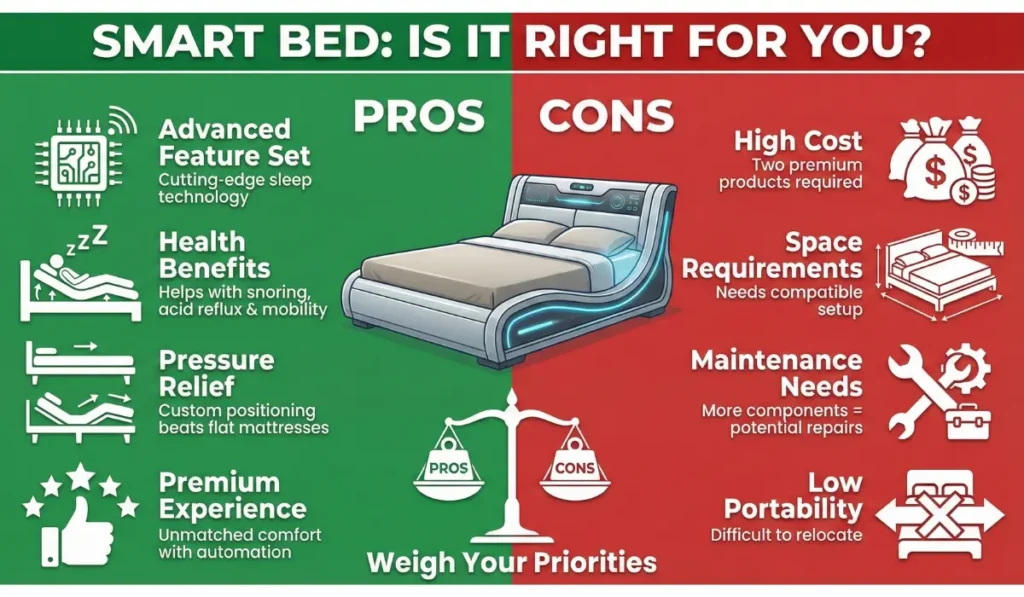
You get the most advanced feature set available in the sleep tech world. If it exists, these systems probably have it.
They can be great for snoring, acid reflux, and mobility issues. The ability to elevate specific body parts can potentially make a significant difference for people dealing with these conditions.
Adjustable positioning can significantly reduce pressure and discomfort in ways a flat mattress simply can’t match, no matter how good the foam or springs are.
If you benefit from elevation and automation—and actually want to use those features regularly—this delivers an experience that’s hard to beat.
Smart Bed Cons
The overall cost sits at the highest end of the spectrum. You’re buying two premium products that need to work together.
These require compatible space and setup. Not every bedroom or bed frame can accommodate them easily.
More mechanical components mean more things that could eventually need repair or maintenance.
They’re substantially less portable and harder to move. If you relocate frequently, this becomes a real consideration.
Who Are Smart Beds Best For
Hot sleepers who need powerful, active body temperature management will appreciate the advanced cooling systems some of these bases offer.
Snorers or people with breathing-related sleep disruption get measurable benefits from the automatic head elevation features.
If you’re dealing with chronic back or joint issues, the ability to adjust positioning throughout the night can genuinely improve how you feel in the morning.
Users who value adjustability and automation over simplicity—and who’ll actually use those features—will get their money’s worth here.
Smart Beds Example Brands
- Tempur-Pedic (ActiveBreeze and ProSmart systems)
What Is a Smart Mattress Cover?
How Smart Mattress Covers Enhance Existing Mattresses
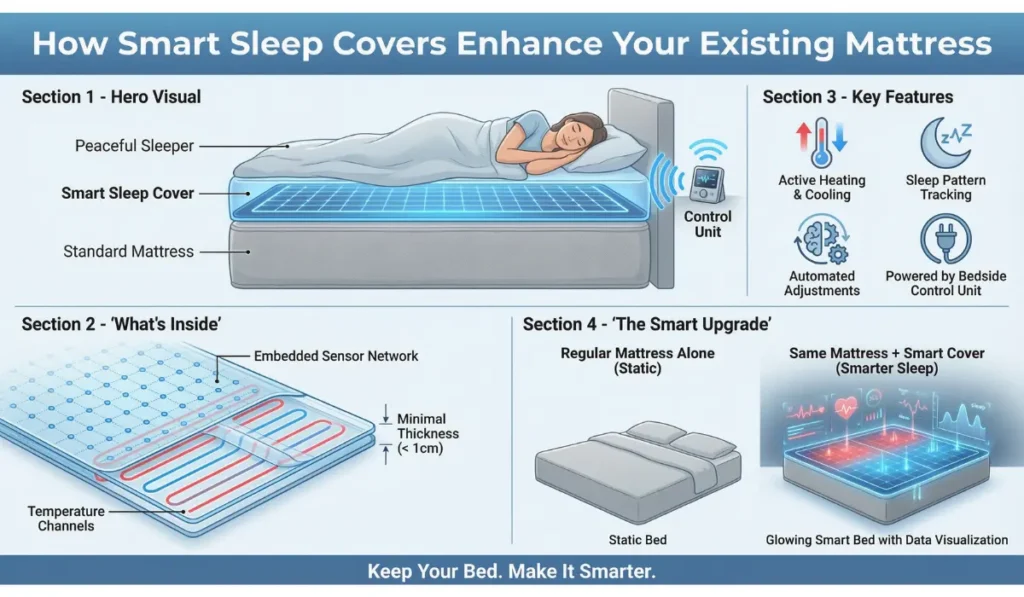
A smart mattress cover is basically a tech layer that goes right on top of your existing mattress.
It includes a network of sensors and temperature channels woven throughout the cover, all powered by a separate control unit that sits beside your bed.
Think of it like a really sophisticated mattress pad, except instead of just adding cushioning, it’s actively managing temperature and tracking your sleep.
The cover adds heating and cooling, sleep tracking, and sometimes automated adjustments based on your sleep patterns—all without touching the actual mattress underneath.
You keep the bed you have. You just make it smarter.
Smart Mattress Cover Subscription Considerations
Here’s where it gets a bit tricky.
Most smart Mattress covers require a monthly or annual subscription to unlock the full experience. Without it, you lose access to things like AI-driven temperature automation, advanced sleep analytics, long-term data storage, and personalized insights about your sleep trends.
Basic functionality of your smart mattress cover might still work without paying, but the experience gets significantly stripped down. You’re essentially buying hardware that needs an ongoing membership to reach its full potential.
This isn’t necessarily bad—it just needs to factor into your total cost calculation.
Mattress Dependency
Your comfort and support depend entirely on the mattress sitting underneath the cover.
If that mattress is already worn out, sagging, or just not supportive enough for your body, the smart mattress cover can’t fix those problems. It can make you cooler or warmer. It can track how poorly you’re sleeping on that bad mattress. But it can’t add support or eliminate pressure points.
The cover enhances what’s already there—it doesn’t replace it.
Smart Mattress Cover Pros
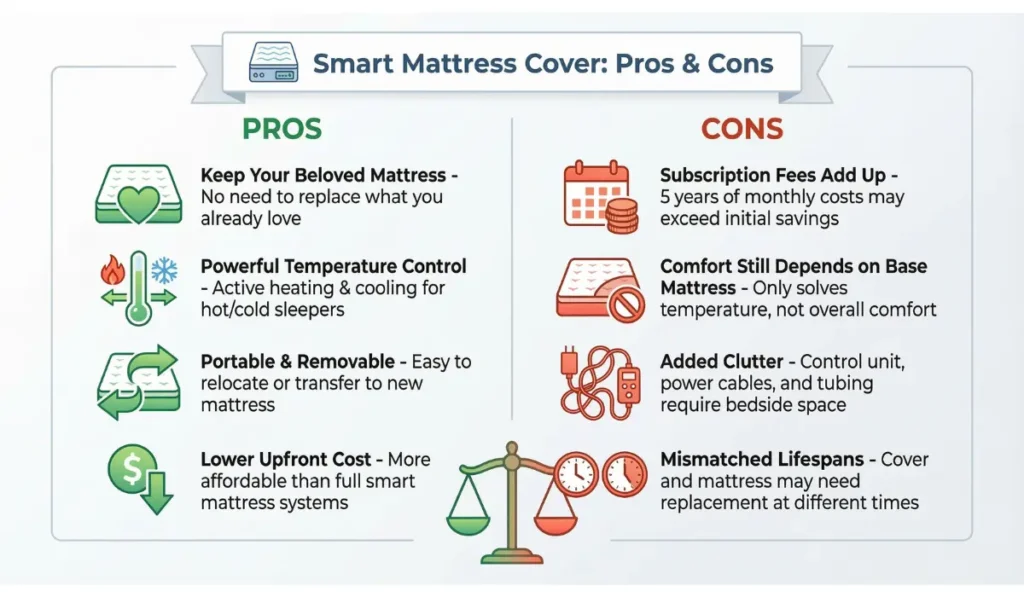
You don’t have to replace a mattress you already love. If your bed feels great but sleeps too hot, this solves that specific problem without forcing you to start over.
Temperature regulation capabilities are generally strong with these systems. The active heating and cooling can make a noticeable difference for hot and cold sleepers.
They’re easy to remove or move, which matters if you relocate often or want to take the tech with you to a new mattress later.
The upfront cost runs lower than buying a full smart mattress or complete bed system, making it a more accessible entry point into sleep technology.
Smart Mattress Cover Cons
The ongoing subscription cost adds up over time. Five years of monthly fees can exceed what you saved upfront compared to other options.
Your comfort is limited by whatever mattress you’re working with. If that’s not ideal, you’re only solving part of the problem.
It adds complexity to your bed setup—you’ve got a control unit, power cables, and tubing that need to live somewhere near your bed.
The technology lifespan runs separate from your mattress lifespan, which means you might need to replace the smart mattress cover while your mattress is still fine, or vice versa.
Who Are Smart Mattress Covers Best For
Sleepers who already love their mattress but have specific issues the smart mattress cover can address—primarily temperature problems—will get the most value here.
Hot or cold sleepers focused on temperature control as their main sleep issue should definitely consider this option.
Data-driven users who genuinely enjoy reviewing sleep analytics and tweaking settings based on trends will appreciate the detailed tracking.
Renters or frequent movers benefit from the portability and the fact that you’re not investing in a full mattress you might need to leave behind.

Smart Mattress Cover Example Brands
- Eight Sleep
Smart Mattress, Beds & Covers: Side-by-Side Comparison
| Feature | Smart Mattress | Smart Bed System | Smart Mattress Cover |
| Replaces mattress | Yes | Yes | No |
| Adjustable firmness | Yes | Sometimes | No |
| Adjustable positioning | No | Yes | No |
| Temperature control | Limited | Advanced (some) | Advanced |
| Sleep tracking | Sometimes | Often | Yes |
| Subscription required | Rare | No | Often |
| Setup complexity | Medium | High | Low |
| Long-term flexibility | Medium | Low | High |
Which Smart Sleep Option Should You Choose?
Pick based on the actual problem you’re trying to solve, not just which product sounds coolest.
You sleep hot or cold → Smart bed system or smart Mattress cover
You have back pain or pressure issues → Smart mattress or smart bed system
You and your partner prefer different firmness → Smart mattress
You love your current mattress → Smart Mattress cover
You want no subscriptions → Smart mattress or smart bed system
You want maximum automation and features → Smart bed system
You move often or rent → Smart Mattress cover
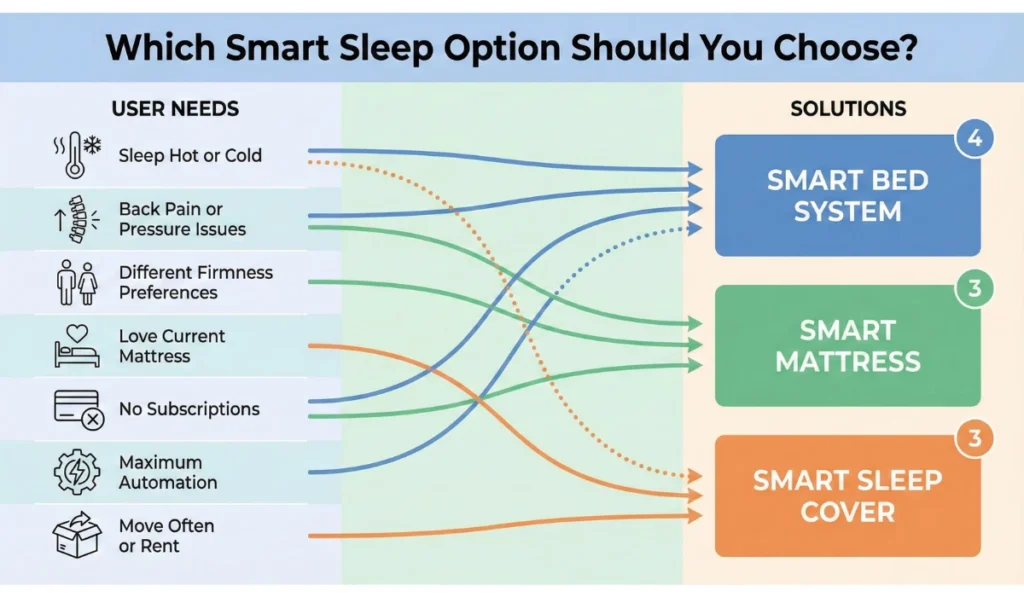
No option wins across the board. The right choice is whichever one actually addresses your specific sleep challenges, fits your lifestyle, and matches how much tech you genuinely want involved in your bedroom.
Common Buying Mistakes to Avoid
Assuming All Smart Beds Are the Same
They’re really not.
Each category solves fundamentally different problems. Buying the wrong type is the number one reason people end up disappointed with their purchase.
Ignoring Long-Term Ownership Costs
Subscriptions add up. Warranties on electronics matter. Repair considerations are real.
The sticker price is just part of the story. Think about what you’ll actually spend over three to five years of ownership.
Expecting Technology to Fix a Bad Mattress
Smart covers and bases can’t compensate for poor underlying support.
If your mattress is already shot, no amount of temperature control or sleep tracking will make it comfortable. Fix the foundation first.
Overpaying for Features You Won’t Use
Be honest with yourself about whether you’ll actually adjust settings regularly or review sleep data.
If you’re not going to engage with the tech, simpler solutions often deliver better value. There’s no shame in admitting you just want a comfortable bed that sleeps cool—you don’t need AI-powered analytics for that.
FAQs
What’s the difference between a smart mattress, a smart bed system and a smart mattress cover?
A smart mattress integrates air chambers and sensors into the mattress itself to adjust firmness and track sleep patterns.
A smart bed system uses a separate motorized base to handle features like adjustable positioning, snore response and sleep‑tracking.
A smart mattress cover is a tech layer that fits over your existing mattress to add heating/cooling and sleep‑tracking sensors without replacing the bed.
How do smart bed systems work and what features do they offer?
Smart bed systems raise or lower the head and feet, provide zero‑gravity positions and automatically lift the head when snoring is detected, while sensors built into the base monitor sleep stages and movement.
Many systems also offer temperature control, adjustable lumbar support and relaxation programs for customised comfort.
Do smart mattress covers require a subscription, and are they worth it?
Most smart mattress covers require a monthly or annual subscription to enable AI‑driven temperature control and detailed sleep analytics.
Without the subscription you still get basic heating, cooling and tracking, but advanced features are disabled; covers are cheaper and portable, yet comfort depends on your existing mattress and fees can add up.
Which smart sleep option should I choose based on my sleep issues?
Hot or cold sleepers should consider smart bed systems or covers with strong temperature control; back‑pain sufferers or those needing different firmness levels benefit from smart mattresses or bed systems; couples with divergent firmness preferences should opt for a smart mattress; and renters or those happy with their current bed may prefer a removable cover.
Smart mattresses and bed systems generally avoid recurring fees, while covers often require them.
What are the leading smart beds that monitor heart rate and breathing?
Top models include the Eight Sleep Pod 5, which uses clinical‑grade sensors to track heart‑rate variability and respiratory rate; Sleep Number i8 with Responsive Air chambers and SleepIQ biometrics monitoring; Tempur‑Pedic TEMPUR‑ActiveBreeze featuring Sleeptracker‑AI® and automatic snore‑response technology; and Bryte Balance Signature with 90 adaptive air chambers and built‑in sleep tracking and relaxation programs.
What are the best high‑tech mattresses with sleep coaching?
Leading options include the TEMPUR‑ActiveBreeze smart bed, which pairs Sleeptracker‑AI coaching with climate control; the Eight Sleep Pod 5 with Autopilot temperature adjustment and detailed sleep insights; the Sleep Number i8, offering SleepIQ data and personalised recommendations; and Bryte Balance Signature, which combines adaptive pressure relief with relaxation programs to help you fall asleep.
Final Thoughts: Understanding Smart Bed Categories
A “smart bed” isn’t one product – it’s a whole category of different solutions that happen to use similar marketing language.
Once you understand the real differences between smart mattresses, smart bed systems, and smart Mattress covers, the buying decision gets a lot clearer. You stop comparing apples to oranges and start evaluating which tool actually fits the job you need done.
The best choice directly addresses your specific sleep challenges, fits into your lifestyle without creating hassle, and aligns with how much technology you genuinely want in your bedroom.
Not how much tech sounds cool in theory. How much you’ll actually use and appreciate over time.
Choose based on that, and you’ll be much happier with whatever you end up buying. As a result, you should hopefully get better rest, deep sleep, and feel recharged in the mornings.
Still not sure which is right for you? Use our calculator for mattress type here.