
If you want to know how to optimize your sleep, you’re in the right place. I’m not going to bore you with the same old advice about putting your phone away an hour before bed or keeping your room cool.
You’ve heard that stuff a million times already.
What I’m going to share with you are the strategies that actually moved the needle for me – and the science-backed techniques that high performers use to get genuinely restorative sleep.
Because here’s the thing: there’s a massive difference between just “getting eight hours” and waking up feeling like you can take on the world.
I spent years thinking I was a “bad sleeper” until I realized I was approaching the whole thing wrong.
Once I started treating sleep optimization like the performance enhancer it actually is, everything changed. My energy levels skyrocketed, my focus sharpened, and I stopped relying on three cups of coffee just to feel human in the morning.
So, let’s get into it!
TL;DR – Quick Sleep Optimization Tips
Here’s what you need to know if you’re in a hurry:
- Your sleep happens in 90-minute cycles – timing your wake-up to match these cycles eliminates that groggy feeling
- Light exposure timing is everything – bright light in the morning and darkness at night are more powerful than most supplements
- Temperature drops help you fall asleep – your body needs to cool down by 2-3 degrees to initiate sleep
- Blue light blocking glasses work – wearing high quality blue light blocking glasses 1-2 hours before bed genuinely improved my sleep quality
- Your bedroom environment matters more than you think – blackout curtains, ear plugs, and even dirty electricity can make or break your sleep
- HRV tracking gives you real feedback – it tells you if your sleep optimization efforts are actually working
- More sleep hacks – see our article on how Navy SEALs can fall asleep so quickly
How Sleep Actually Works – A Quick Run Down
Most people think sleep is just an “off switch” for your brain.
It’s not.
Your brain is incredibly active while you sleep, just in different ways.
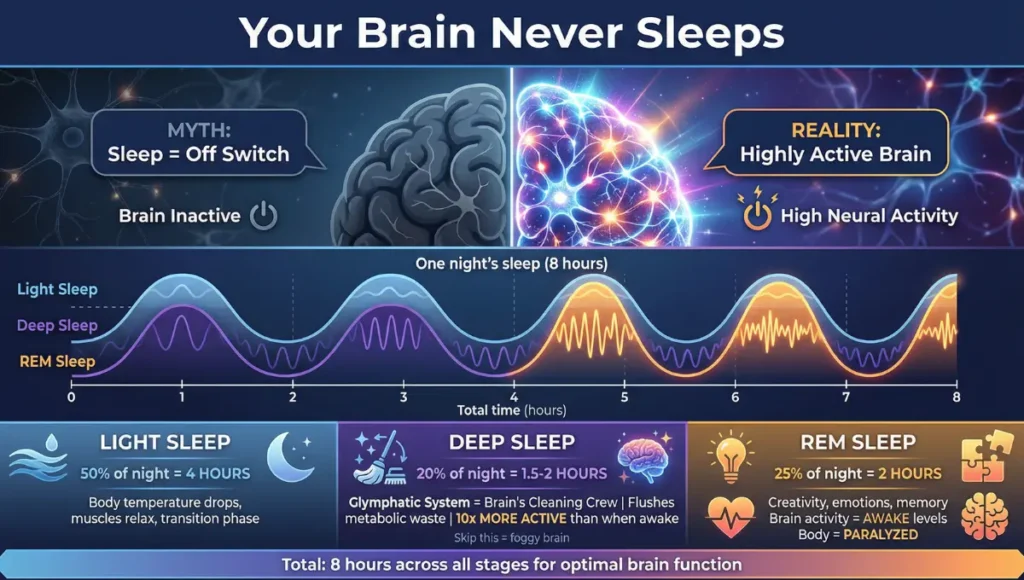
Every night, you cycle through different sleep stages about 4-6 times. Each cycle lasts roughly 90 minutes and includes light sleep, deep sleep, and REM sleep.
However, each stage does something completely different for your body and brain.
Deep sleep (also called slow-wave sleep) is when your brain’s cleaning crew shows up. There’s a system called the glymphatic system that literally flushes out metabolic waste from your brain. It’s up to 10 times more active during sleep than when you’re awake.
This is one reason why pulling all-nighters feels so awful – your brain doesn’t get its nightly cleaning session.
That said, REM sleep is where the magic happens for creativity, emotional processing, and memory consolidation. The weird thing is that your brain is almost as active during REM as when you’re awake, but your body is essentially paralyzed so you don’t act out your dreams.
Here’s what most people miss:
The proportion of these stages shifts throughout the night. You get more deep sleep in the first half of the night and more REM sleep in the second half.
So when you cut your sleep short by even an hour, you’re losing a disproportionate amount of REM sleep. That’s why you feel foggy and emotionally off after a shortened night.
Tip #1: Master Your Light Exposure Timing
Here’s where learning how to optimize your sleep gets really interesting. Your body has an internal clock called the suprachiasmatic nucleus – basically your master timekeeper. It responds primarily to light, but also to temperature, food, and exercise.
The timing, intensity, and type of light you’re exposed to completely changes how your body regulates sleep.
Getting 10,000 lux of bright light within 30 minutes of waking up is ideal. If you can’t get outside (which is the best option), even 20-30 minutes from a light therapy box at 1,000-2,500 lux makes a real difference.
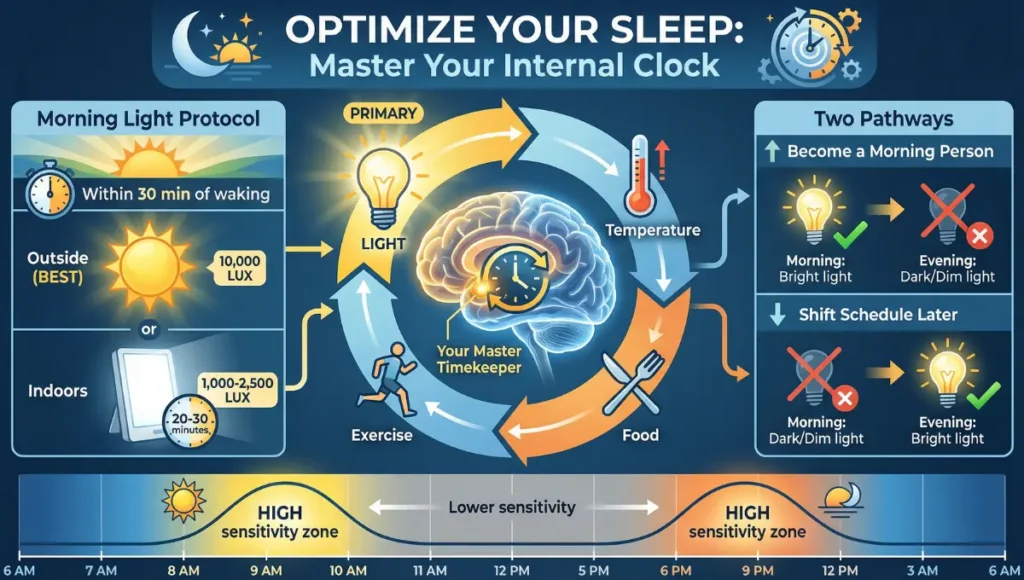
Your circadian system is most sensitive to light in the early morning and late evening.
If you want to become more of a morning person, you need bright light immediately after waking and zero bright light in the evening. If you’re trying to shift later, do the opposite.
Why Blue Light Actually Matters
This is where blue light blocking glasses come into play, and I’m not just saying that because they’re popular. The science actually backs this up – and I’ve also personally noticed a big improvement in my sleep since using them.
So, blue wavelengths specifically suppress melatonin production more than any other part of the light spectrum.
During the day, that’s great – it keeps you alert.
In the evening, it’s a problem because it tricks your brain into thinking it’s still daytime.
I started wearing blue light blocking glasses for 1-2 hours before bed about a year ago, and it genuinely changed my sleep. I fall asleep faster, and I wake up feeling more refreshed. For me, the difference was noticeable within the first week.
If you’re serious about sleep optimization, get yourself a pair of quality blue light blocking glasses. Wear them starting about 2 hours before your target bedtime. They filter out the wavelengths that suppress melatonin while still letting you see clearly.
There are tons of blue light blocking glasses brands out there, but this is the brand that I personally went with.
Tip #2: Strategic Temperature Control
Your core body temperature needs to drop by 2-3 degrees Fahrenheit to initiate and maintain sleep. Most people know to keep their bedroom cool (around 60-68°F is ideal), but there are much smarter ways to approach this.
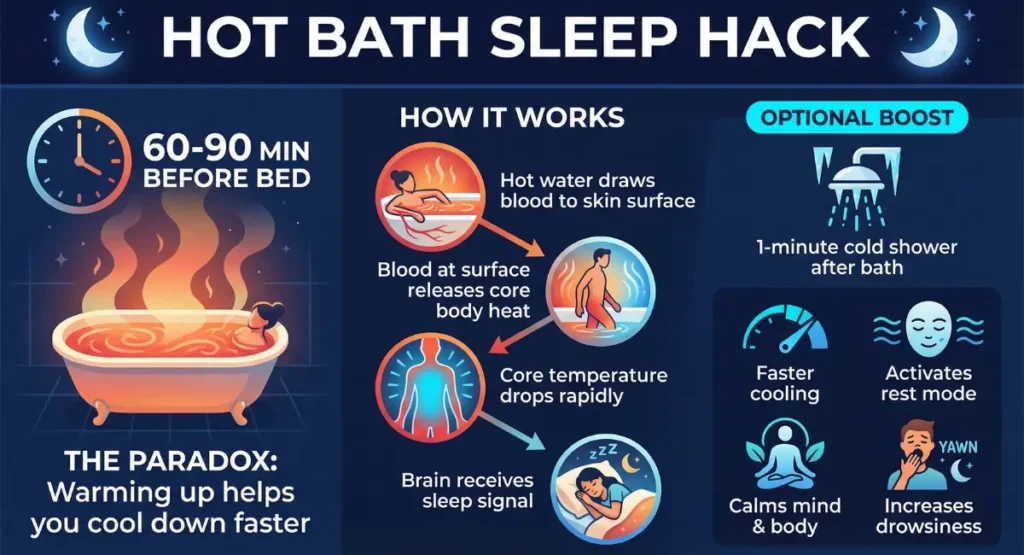
Taking a warm bath or shower about 60–90 minutes before bed can actually help you cool down faster and fall asleep more easily. It sounds backwards, but here’s what’s going on.
Warm water brings more blood to the surface of your skin. When you get out of the bath or shower, that blood releases heat into the surrounding air, which helps your core body temperature drop more quickly.
That drop is one of the strongest signals your brain uses to switch into sleep mode.
If you want to experiment with it, then here’s an additional step that may make you more drowsy after your bath:
So, some people (myself included) find that finishing your bath with a very brief cool rinse (10–30 seconds, not freezing) can feel calming and refreshing. The quick temperature contrast can leave the body feeling more relaxed — though it’s not essential, and it doesn’t suit everyone.
If cold showers tend to wake you up, it’s best to skip this part.
The key takeaway is simple: warmth earlier in the evening, followed by natural cooling, helps your body do what it’s designed to do — wind down and get ready for sleep.
I’ve also found that wearing socks to bed – which sounds weird – actually works through something called distal vasodilation.
Warming your hands and feet increases blood flow to those areas, which helps release core body heat. Research shows this can reduce the time it takes to fall asleep by 7-10 minutes so I decided to give it a go.
This does work for me in the winter, but I don’t wear my socks in bed during the summer (or when my girlfriend stays over!)
Here’s a comparison of temperature strategies:
| Strategy | How It Works | Expected Result |
|---|---|---|
| Cool bedroom (60-68°F) | Supports natural temperature drop | Better sleep maintenance |
| Warm bath 60-90 min before bed | Creates rebound cooling effect | Faster sleep onset (10-15 min) |
| Wearing socks | Increases distal vasodilation | Faster sleep onset (7-10 min) |
| Cooling pillow/mattress pad | Targets thermoreceptors directly | Reduced night wakings |
| Programmable thermostat | Matches natural rhythm changes | Better overall sleep quality |
Tip #3: Time Your Caffeine Intelligently
Caffeine blocks adenosine receptors in your brain. Adenosine is a chemical that builds up throughout the day and creates that feeling of sleepiness – your sleep pressure.
Here’s the thing most people don’t realize: caffeine doesn’t reduce adenosine levels. It just temporarily blocks adenosine from binding to receptors. When the caffeine wears off, all that accumulated adenosine hits you at once.
That’s the infamous caffeine crash.
Caffeine has a half-life of about 5-6 hours for most people. That means if you have 200mg of caffeine at 2 PM, you still have 100mg in your system at 8 PM, 50mg at 2 AM, and 25mg at 8 AM the next morning.
To get caffeine down to levels that won’t interfere with sleep, you need to allow for about three half-lives – that’s 15-18 hours. If you’re going to bed at 10 PM, your last caffeine should be no later than noon, and ideally even earlier.
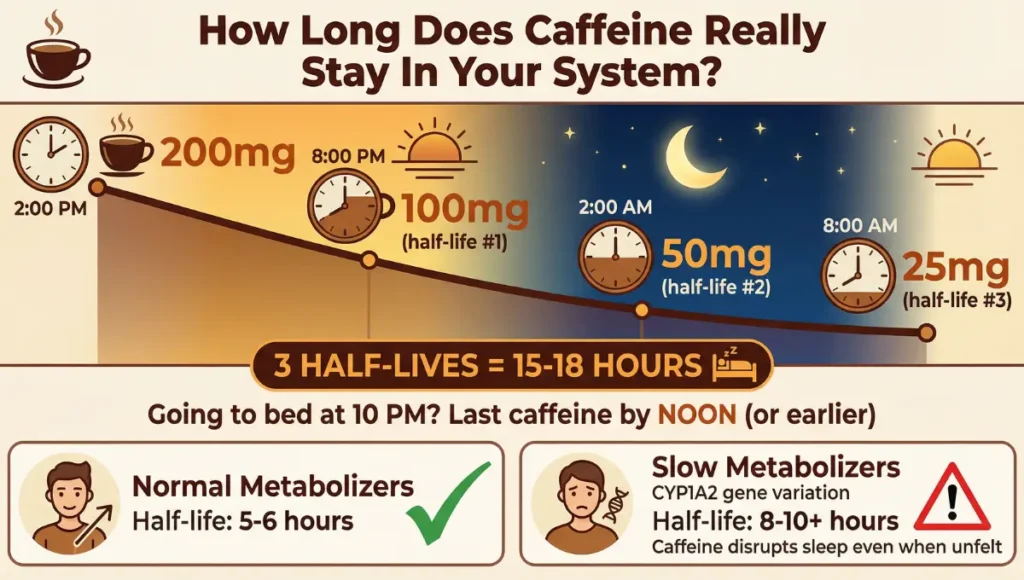
Some people are slow metabolizers due to genetic variations in the CYP1A2 gene.
If you’re a slow metabolizer, caffeine can stay in your system for 8-10 hours or longer, seriously disrupting your sleep even when you don’t consciously feel its effects.
Tip #4: Understand and Track Your Sleep Cycles
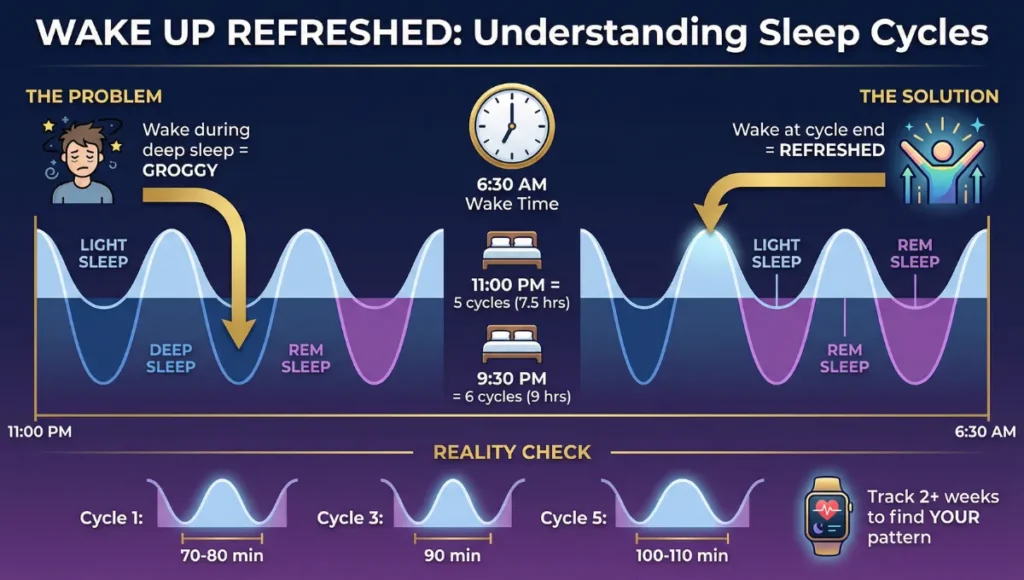
Sleep happens in roughly 90-minute cycles. Each cycle includes light sleep, deep slow-wave sleep, and REM sleep. The deeper the sleep stage you’re in when you wake up, the groggier you’ll feel.
The strategy is to time your wake-up for the end of a complete cycle when you’re in lighter sleep.
If you need to wake at 6:30 AM, going to bed at 11:00 PM (7.5 hours, or five complete cycles) or 9:30 PM (9 hours, or six complete cycles) theoretically aligns with natural cycle endings.
However, it’s more complex in practice because cycles aren’t exactly 90 minutes. The first cycle might be 70-80 minutes, while later cycles can extend to 100-110 minutes.
This is where sleep tracking becomes valuable.
After tracking for a couple weeks, you can identify your personal patterns.
Using HRV as Your Sleep Report Card
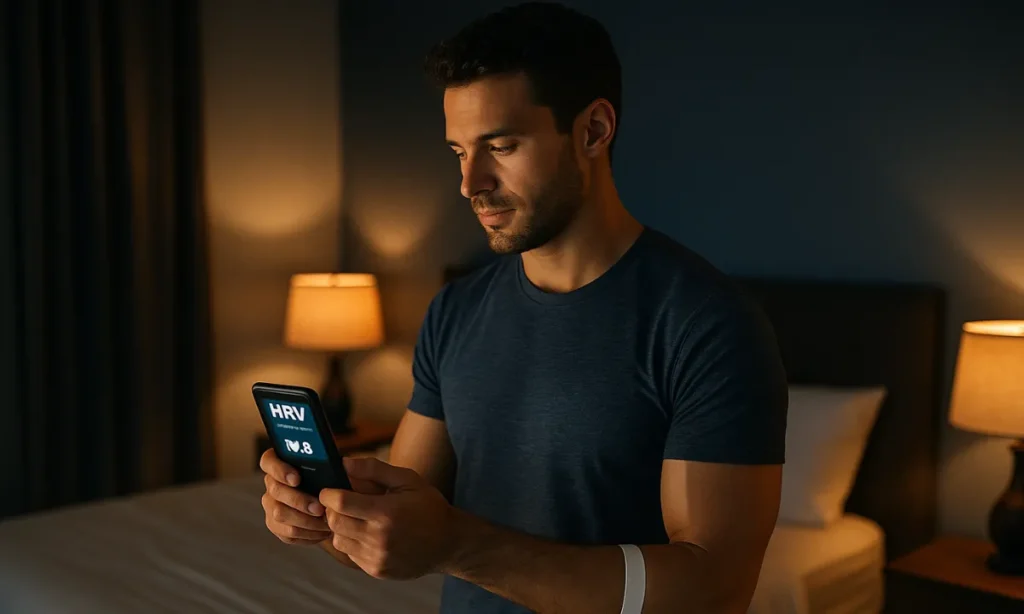
Heart rate variability (HRV) measures the variation in time between your heartbeats. It’s one of the best indicators of whether your body is actually recovering during sleep.
During quality sleep, your HRV should increase, showing that your parasympathetic nervous system (your “rest and digest” mode) is dominant.
If your HRV is low during sleep, something is interfering with recovery – maybe overtraining, stress, late eating, or alcohol.
What makes HRV so valuable is that it gives you objective feedback on whether your sleep strategies are working. You might feel like you slept well, but if your HRV shows poor recovery, something’s off.
Conversely, you might feel like your sleep was disrupted, but if HRV shows good recovery, your body got what it needed.
Tip #5: Optimize Your Sleep Environment
Most people think they’ve nailed their sleep environment if they have a comfortable mattress and it’s reasonably dark. But there are specific environmental factors that can make a huge difference.
My Personal Sleep Environment Transformation
I want to share what actually worked for me because I tried a lot of things, and some made a real impact while others were just hype.
Blackout curtains
Blackout curtains were the first game-changer.
I thought my bedroom was dark enough, but once I installed proper blackout curtains, I realized how much ambient light was still getting through. Even tiny amounts of light can suppress melatonin production. My sleep became noticeably deeper within days.
Silicone ear plugs
Silicone ear plugs were another surprise winner.
I live on a relatively quiet street, but I didn’t realize how much low-level noise was fragmenting my sleep. Random car sounds, the heating system kicking on, neighbors moving around – it all adds up.
With silicone ear plugs, my sleep became more continuous, and I stopped waking up at 3 AM for no apparent reason.
Dirty electricity
The most unexpected improvement came from addressing dirty electricity. I had never heard of this until I started really diving deep into sleep optimization. Dirty electricity refers to electromagnetic interference that travels along electrical wiring and radiates into your living space.
I tested the wall behind my bed with an EMF meter and found surprisingly high readings.
After installing a dirty electricity filter in my bedroom, I noticed an nice improvement in how rested I felt in the morning. I also noticed that I was less restless during the night with fewer wakings. I had more energy throughout the day and felt less “wired but tired” in the evenings.
Blue light blocking glasses
I also started wearing blue light blocking glasses in the evenings, usually for about two hours before bed, and swapped out the regular light bulbs for low–blue light bulbs in the rooms I spend most of my time in at night — the kitchen, living room, and bedroom.
The difference was honestly very noticeable. My mind felt calmer, less “switched on,” and it became much easier to wind down before sleep.
If you’re looking to reduce blue light exposure in the evenings, I’d definitely recommend checking out these blue light blocking glasses here.
They’re the same brand I use myself, so I can genuinely vouch for them — they work well and have become a simple but effective part of my evening routine.
Other Environmental Factors to Consider
Beyond what worked specifically for me, here are other factors worth considering:
- Air quality: Poor air quality can disrupt sleep even if you don’t consciously notice it. Consider an air purifier if you live in an area with pollution or allergens.
- Humidity: The ideal range is 30-50%. Too dry and your airways get irritated; too humid and it feels stuffy.
- Mattress and pillow quality: You spend a third of your life on these. If yours are more than 7-10 years old, they’re probably compromised.
- Electromagnetic fields: Beyond dirty electricity, consider keeping your phone in airplane mode and moving charging devices away from your bed.
Managing Sleep Anxiety (The Hidden Sleep Killer)
Here’s something nobody talks about: the more you try to optimize your sleep, the more anxious you can become about it.
There’s actually a term for this – orthosomnia – where people become so obsessed with perfect sleep metrics that the anxiety itself disrupts their sleep.
Seriously.
Some people get obsessed about tracking everything – checking stats every morning and getting frustrated when their deep sleep percentage isn’t where they want it to be every single day. The irony is that this anxiety can make their sleep worse.
Sleep requires a certain amount of ‘letting go’.
You can’t force yourself to sleep through willpower, and the harder you try, the more elusive it becomes.
The Paradoxical Intention Technique
This technique also deserves a mention here, and it completely changed my relationship with sleep.
So, instead of ‘trying’ to fall asleep, you actually try to stay awake while lying in bed comfortably with your eyes closed – but you think of nothing and allow your mind to be still and quiet.
This removes the performance anxiety around sleep, and ironically, most people fall asleep quickly when they stop trying to force it.
I use this whenever I notice myself getting frustrated about not being asleep yet. It works almost every time.
Stimulus Control Therapy
If you’re lying awake in bed for more than 15-20 minutes, get up and do something relaxing in another room. Only return to bed when you feel genuinely sleepy again.
This sounds simple, but it’s incredibly powerful because it reconditions your brain to associate your bed with sleep, not with lying awake feeling frustrated.
Enhancing Specific Sleep Stages Based on Your Goals
Different sleep stages serve different purposes, so you might want to prioritize specific stages depending on what you’re trying to achieve.
For Physical Recovery (Deep Sleep)
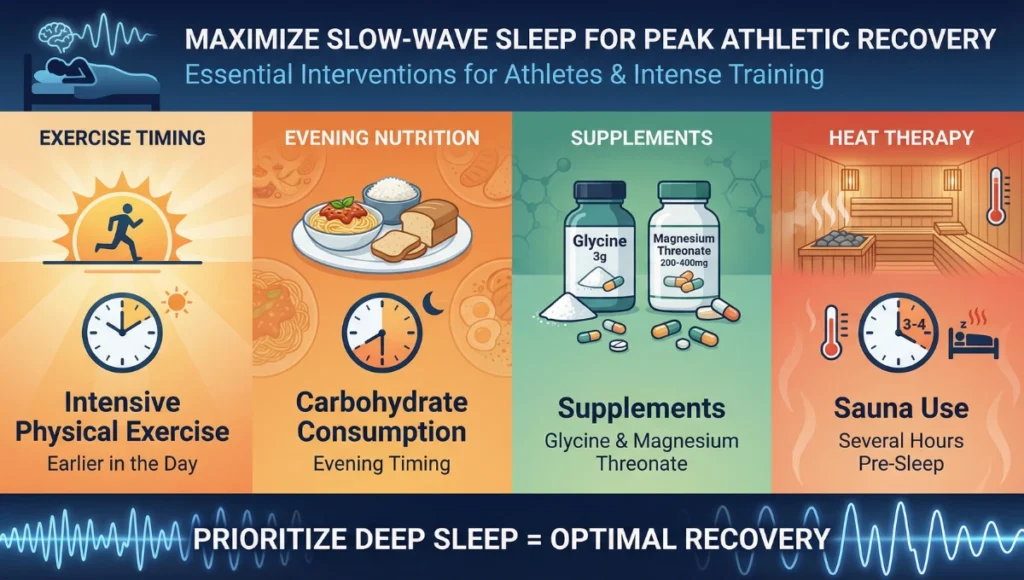
If you’re an athlete or doing intense physical training, prioritize slow-wave sleep.
The most effective interventions are:
- Intensive physical exercise earlier in the day
- Evening carbohydrate consumption
- Supplements like glycine (3g) or magnesium threonate (200-400mg)
- Sauna use several hours before bed
For Creativity and Emotional Processing (REM Sleep)
If you’re working on creative projects or dealing with emotional stuff, you need to protect REM sleep.
This means:
- Protecting your total sleep time (cutting sleep short disproportionately affects REM)
- Avoiding alcohol completely (it devastates REM sleep even in small amounts)
- Consider choline supplementation
- Practice dream journaling and reality testing
If you wan to protect your REM sleep, then Blue light blocking glasses worn 1-2 hours in the evening before bed in the evening help maintain your natural melatonin rhythm for better sleep architecture.
Common Sleep Supplements That Actually Work
I’m generally skeptical of supplements, but a few have solid research backing:
- Magnesium glycinate or threonate (200-400mg): Helps if you’re deficient and supports relaxation
- Glycine (3g before bed): Shown to improve subjective sleep quality and reduce core body temperature
- L-theanine (200-400mg): Promotes relaxation without sedation
- Apigenin (around 50mg): Acts as a mild benzodiazepine receptor modulator
That said, supplements should complement behavioral changes, not replace them. Start with the environmental and behavioral stuff first.
Here’s a video worth checking out from Dr Huberman:
The Sleep Optimization Checklist
Here’s a quick checklist to help you implement these strategies:
Evening Routine (2 hours before bed):
- Put on blue light blocking glasses
- Dim all lights in your home
- Set thermostat to 60-68°F
- No caffeine (should have stopped by noon)
- No alcohol
- No large meals
Pre-Bed (60-90 minutes before):
- Take a warm bath or shower
- Put in ear plugs
- Ensure blackout curtains are closed
- Put phone in airplane mode
- Check room temperature
Morning Routine:
- Get bright light exposure within 30 minutes of waking
- Consistent wake time (even on weekends)
- Note how you feel for tracking purposes
Optimized Sleep FAQs
What is sleep architecture and why should I care?
Sleep architecture is the pattern of sleep stages you cycle through each night.
Each 90-minute cycle includes light sleep, deep sleep, and REM sleep.
Understanding this matters because different stages serve different purposes – deep sleep clears waste from your brain and supports physical recovery, while REM sleep handles memory consolidation and emotional regulation.
When you know your patterns, you can make targeted improvements.
Does caffeine really mess with my sleep if I have it in the afternoon?
Absolutely.
Caffeine has a half-life of 5-6 hours, meaning half of it is still in your system six hours later.
To be completely metabolized, you need about three half-lives (15-18 hours).
So that 2 PM coffee?
It’s still affecting your brain chemistry at bedtime, even if you don’t feel wired.
What’s the glymphatic system?
Think of it as your brain’s nightly cleaning service.
During sleep, especially deep sleep, the space between your brain cells expands and cerebrospinal fluid flushes through, washing away metabolic waste that built up during the day.
This system is up to 10 times more active during sleep than when you’re awake.
Poor sleep means poor cleaning, which is one reason chronic sleep deprivation is linked to neurodegenerative diseases.
Can I train myself to need less sleep?
No.
You can adapt to feeling less sleepy, but objective measures show your cognitive performance, reaction time, and decision-making remain impaired.
Sleep need is largely genetic – most adults need 7-9 hours.
Claims about functioning well on 4-5 hours typically reflect either chronic sleep deprivation or unrealistic self-assessment.
How accurate are sleep tracking devices?
They vary, but devices that measure heart rate and movement provide reasonable estimates of sleep stages.
They’re not as accurate as medical-grade polysomnography, but they’re great for identifying trends over time.
The most useful feature is HRV measurement, which gives you objective recovery data.
What room temperature is best for sleep?
Most people sleep best between 60-68°F.
Your body needs to drop its core temperature by 2-3 degrees to initiate sleep, and a cool room supports this.
Even small adjustments of 2-3 degrees can make a noticeable difference.
Final Thoughts: How to Optimize Your Sleep Starting Tonight
Learning how to optimize your sleep isn’t about implementing every single strategy at once.
Start with the basics that will give you the biggest return:
- Get bright light in the morning and wear blue light blocking glasses in the evening
- Cut off caffeine by noon
- Take a warm shower 60-90 minutes before bed
- Keep your bedroom cool, dark, and quiet
- Track your sleep to see what’s actually working
For me, the combination of blue light blocking glasses, blackout curtains, ear plugs, and addressing dirty electricity transformed my sleep from “okay” to genuinely restorative.
Your combination might be different – the key is systematic experimentation and tracking.
If you’re just getting started with sleep optimization, then beginning with blackout curtains, hot baths 2 hours before bed, silicone ear plugs, and wearing blue light blocking glasses is an easy and affordable place to start that make a real difference.
The difference between good sleep and great sleep often comes down to the details.
When you understand the biology behind sleep and work with your body’s natural systems instead of against them, you unlock a level of energy and mental clarity that most people don’t even know is possible.
Now you know how to optimize your sleep. Time to put it into practice.
More Sleep Optimization Articles