

Choosing the right mattress is only half the decision.
The support underneath it matters just as much.
If your mattress feels uncomfortable, wears out too quickly, or sags early, the issue may not be the mattress itself—it may be the mattress box spring or base.
Many people still assume a box spring is essential, but modern mattresses often need a different type of support.
This guide answers one clear question:
Do you really need a box spring for your mattress?
In this article you will learn when a box spring helps, when it harms, and what support system actually works best for your specific mattress type.
Key Takeaways: Box Spring vs Modern Mattress Support
- Most modern mattresses do not need a box spring.
- Box springs were designed for traditional innerspring mattresses.
- Memory foam, latex, and hybrid mattresses need firm, even support.
- Incorrect support can reduce mattress lifespan and void warranties.
- Alternatives like platform beds and foundations often provide better support.
- Most mattresses last around 7–10 years, depending on materials and care.
What Is a Box Spring?
A box spring is a support base made of a wooden frame with metal coils or a metal grid, covered in fabric.
What is the purpose of a box spring?
A box spring was created to:
- absorb shock
- support innerspring mattresses
- improve airflow
- raise bed height
Box springs were originally designed to work with traditional coil mattresses.
This matters because modern mattresses are built differently.

Box spring vs foundation: key difference
- A box spring contains coils that add flexibility and bounce.
- A foundation uses slats or solid panels to provide firm, even support.
This difference explains why many modern mattresses no longer benefit from a box spring.
Do You Need To Use a Box Spring Nowadays?
Short answer: Usually no.
Most mattresses today do not require a box spring.
Why box springs are often unnecessary now
Modern mattresses are designed with dense foam layers or hybrid structures. These materials need a flat, stable surface.
When used with foam or hybrid mattresses, box springs can:
- cause uneven support
- increase sagging
- reduce durability
- conflict with warranty requirements
For example, memory foam mattresses need slats spaced roughly 2–3 inches apart to prevent sagging and maintain proper support.
When a box spring is still needed
A box spring can still be needed if:
- you use a traditional innerspring mattress
- your bed frame requires a box spring for structural support
- you want extra height and a softer feel
In these cases, a box spring can still be practical.
Why support choice affects mattress lifespan
Mattresses typically last between 7 and 10 years, depending on materials and usage.
Using the wrong support base can shorten that lifespan significantly.
Box Spring Pros & Cons
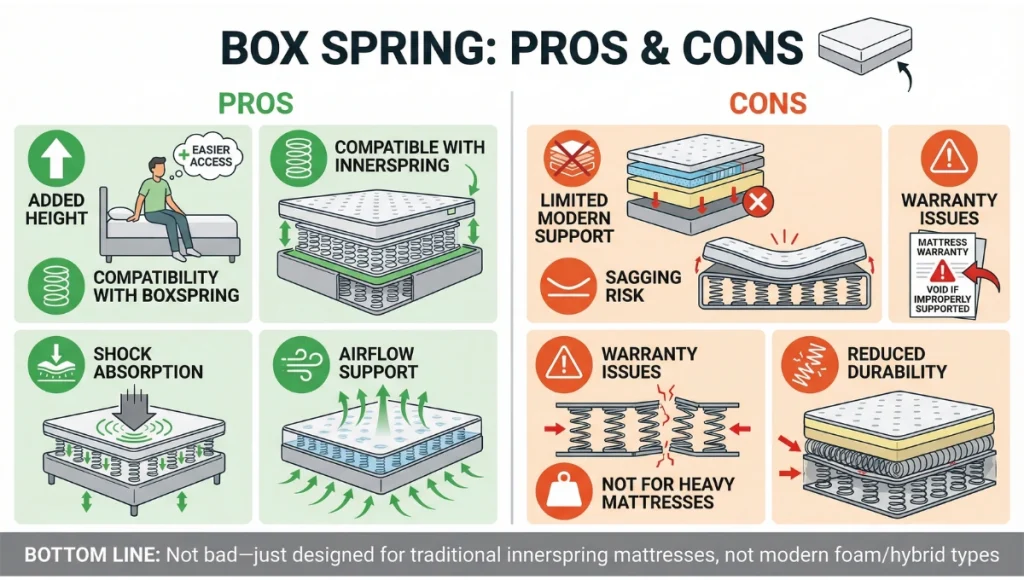
Box Spring Pros
Added height: This is great because it makes beds easier to access and improves bedroom aesthetics.
Compatibility with traditional innerspring mattresses: This allows older coil mattresses to perform as designed.
Shock absorption: This can slightly reduce stress on mattress coils.
Airflow support: Box springs can improve ventilation under certain mattress types.
Box Spring Cons
Limited support for modern mattresses: Foam and hybrid mattresses often need firmer, flatter surfaces.
Higher risk of sagging: Uneven spring spacing can lead to mattress dips and wear.
Potential warranty issues: Some manufacturers require specific support systems.
Reduced durability: Box spring coils can weaken over time, reducing stability.
Not ideal for heavy mattresses: Dense foam or latex can strain spring-based foundations.
Bottom line: A box spring is not inherently bad. It is simply designed for a different type of mattress.
Box Spring Alternatives: Modern Mattress Support Options
What can you use instead of a box spring?
Several modern support systems replace the traditional box spring.
The right choice depends on your mattress type, bed frame, and comfort goals.
Most common box spring alternatives
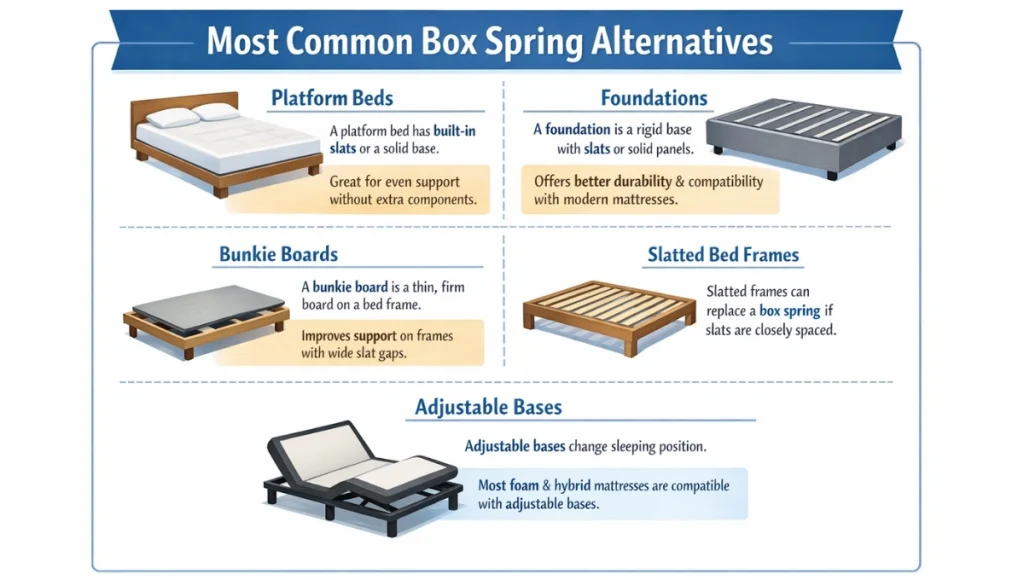
Platform beds
A platform bed has built-in slats or a solid base.
This is great because it provides even support without extra components.
Foundations
A foundation is a rigid base with slats or solid panels.
This allows you to experience better durability and compatibility with modern mattresses.
Bunkie boards
A bunkie board is a thin, firm board placed on a bed frame.
This is useful because it improves support on frames with wide slat gaps.
Slatted bed frames
Slatted frames can replace a box spring if slats are closely spaced.
Adjustable bases
Adjustable bases change sleeping position and require flexible mattresses.
Most foam and hybrid mattresses are compatible with adjustable bases.
If you’re in the process of choosing a new mattress, it may also be helpful to explore some of the best budget mattresses available today.
Many affordable mattresses are designed to work perfectly with platform beds or slatted frames, giving you solid support without the added cost of a traditional box spring.
Comparison Table: Box Spring vs Alternatives
| Support Type | Best For | Key Benefit | Main Limitation |
| Box spring | Traditional innerspring mattresses | Shock absorption | Poor support for foam |
| Platform bed | Foam, hybrid, latex | Even support | Less airflow in some designs |
| Foundation | Most modern mattresses | Stability and durability | Less flexibility |
| Bunkie board | Weak bed frames | Extra firmness | Adds little height |
| Adjustable base | Foam and hybrid mattresses | Custom comfort | Higher cost |
Mattress Requirements by Mattress Type
The type of mattress you own determines whether a box spring is helpful or harmful.
Each mattress construction interacts differently with its support base, which affects comfort, durability, and warranty coverage.
Choosing the correct support system is not optional.
It directly influences how well your mattress performs over time.
Innerspring Mattresses
Traditional innerspring mattresses are the only category where a box spring can still make practical sense.
These mattresses use interconnected coil systems that benefit from airflow and a degree of flexibility beneath the surface.
A box spring can support this design by absorbing shock and reducing stress on the coils.
However, a box spring is not always required. Many modern innerspring mattresses perform just as well on firm foundations or closely spaced slatted frames.
The key requirement is even support across the mattress surface, without gaps that allow coils to sag or shift.
Memory Foam and All-Foam Mattresses
Memory foam and all-foam mattresses require a flat, rigid base. Their dense foam layers are designed to contour to the body, which means they need consistent support underneath to prevent sagging and structural breakdown.
A traditional box spring is usually unsuitable because the gaps between springs allow foam to compress unevenly.
Platform beds, solid foundations, or slatted frames with narrow spacing provide the most reliable support. This setup helps maintain the mattress shape, improves longevity, and aligns with most manufacturer guidelines for foam-based mattresses.
Latex Mattresses
Latex mattresses are heavy, resilient, and structurally dense. They need strong, uniform support to maintain stability and prevent long-term deformation.
While latex is naturally breathable, it still requires a firm base that distributes weight evenly across the surface.
A platform bed, solid foundation, or tightly spaced slats are typically the most effective options. Traditional box springs are rarely recommended for latex mattresses because they lack the stability required for heavier materials and can contribute to uneven wear over time.
Hybrid Mattresses
Hybrid mattresses like the Saatva Classic or the Saatva RX combine coil systems with foam or latex comfort layers, which means they require both stability and airflow. A box spring often fails to meet these dual requirements because it can allow foam layers to compress unevenly while offering inconsistent support for the coil system.
Platform beds, firm foundations, or high-quality slatted frames are generally better suited to hybrid mattresses. These options provide a stable base for foam layers while still allowing airflow around the coils, helping preserve comfort and structural integrity.
Smart Beds
Most smart beds do not need a box spring. Smart beds typically use adjustable bases with built-in motors and articulated sections that raise and lower different parts of the mattress.
These systems are designed to provide full structural support on their own, which means a traditional box spring would be unnecessary and could even interfere with how the bed functions.
In fact, placing a smart bed mattress on top of a box spring would prevent the adjustable base from flexing correctly.
Smart bed mattresses are usually foam, latex, or hybrid designs, all of which require firm, stable, and even support. Because smart beds already include this engineered support within the adjustable base, adding a box spring would add height without adding any real benefit.
If you own a smart bed, the correct setup is almost always the mattress placed directly onto the manufacturer-supplied adjustable frame, not on a box spring or foundation.
Mattress Support Options Beyond the Box Spring
Modern mattresses are designed to work with support systems that provide consistent, even weight distribution. For many sleepers, alternatives to the traditional box spring offer better performance, longer mattress lifespan, and greater compatibility with modern materials.
Platform beds, foundations, bunkie boards, and adjustable bases are now widely used because they align more closely with the structural needs of foam, latex, and hybrid mattresses.
These options reduce sagging, improve stability, and often meet manufacturer requirements for warranty coverage. In most cases, they also provide a simpler and more durable support solution than a traditional box spring.
Platform Beds
Platform beds feature built-in slats or a solid surface that supports the mattress without additional components. They are widely recommended for memory foam, latex, and hybrid mattresses because they provide even, stable support across the entire surface.
This is effective because it prevents foam compression in unsupported areas and reduces the risk of long-term sagging. Platform beds also eliminate the need for a separate box spring, which simplifies bed setup and improves compatibility with modern mattress designs.
Bed Foundations
A bed foundation is a rigid base designed to replace a box spring while offering firmer support. Unlike traditional box springs, most foundations use solid panels or closely spaced slats rather than springs.
Foundations are suitable for almost all mattress types and are particularly effective for foam and hybrid mattresses. This allows the mattress to maintain structural integrity over time while providing stable, uniform support that aligns with most manufacturer recommendations.
Bunkie Boards
A bunkie board is a thin, firm panel placed on top of a bed frame or slats. It is commonly used to strengthen support when slat spacing is too wide or when the bed frame lacks sufficient rigidity.
This is useful because it creates a flatter surface beneath the mattress without significantly increasing bed height. Bunkie boards are often used as a practical solution for improving support on older or less robust bed frames.
Adjustable Bed Frames and Bases
Adjustable bases allow the head and foot of the bed to be raised or lowered to improve comfort and positioning. Most memory foam, latex, and hybrid mattresses are compatible with adjustable bases because they can flex without damaging internal structures.
Traditional innerspring mattresses with continuous coil systems are less suitable, as repeated bending can strain the coil network. Compatibility should always be confirmed with the mattress manufacturer to avoid structural damage or warranty issues.
Traditional Bed Frames and External Support
Many traditional bed frames do not provide sufficient support on their own. Frames with widely spaced slats or minimal central reinforcement often require an additional support layer to prevent mattress sagging and structural strain.
In these cases, a box spring, foundation, or bunkie board acts as a load-distribution system. This ensures that the mattress rests on a stable surface and that weight is evenly distributed across the frame.
Without adequate external support, both the mattress and the bed frame are more likely to degrade prematurely.
Box Spring FAQs (NLP-Optimised for Google PAA and LLMs)
Can you put a mattress directly on the floor?
Yes, but it is generally not recommended.
Placing a mattress directly on the floor restricts airflow, increases moisture retention, and can contribute to mould, allergens, and faster material breakdown. It also provides inconsistent support, which can shorten mattress lifespan and affect comfort.
Do you need a box spring with a platform bed?
No.
A platform bed is designed to support a mattress without a box spring. Adding a box spring is usually unnecessary and may reduce support quality for modern mattresses such as memory foam and hybrids.
What is the best support for a heavy memory foam mattress?
The best support is a flat, rigid surface such as a platform bed, solid foundation, or slatted frame with narrow spacing.
These options provide even weight distribution and prevent foam compression in unsupported areas, which helps maintain mattress structure and durability.
How do you know if a box spring is worn out?
Common signs include sagging, creaking noises, broken springs, and uneven surfaces.
If the mattress feels less supportive or develops dips, the box spring may no longer provide adequate support and should be replaced.
What is the difference between a box spring and a foundation?
A box spring contains metal springs designed to absorb shock and add flexibility.
A foundation uses solid panels or tightly spaced slats to provide firm, even support. Foundations are generally better suited to modern mattresses such as foam, latex, and hybrids.
When is a box spring necessary?
A box spring is most suitable for traditional innerspring mattresses designed to work with spring-based support.
It may also be used when required by a bed frame design or when additional bed height is desired. For most modern mattresses, a box spring is optional rather than essential.
Can using the wrong support damage a mattress?
Yes.
Using an incompatible support system can cause uneven wear, sagging, reduced comfort, and structural damage. In many cases, it can also void the manufacturer’s warranty.
How does a box spring affect mattress lifespan?
When paired correctly with a compatible mattress, a box spring can help distribute weight and reduce stress on coils.
When paired incorrectly, especially with foam or hybrid mattresses, it can accelerate wear and shorten mattress lifespan.
Final Thoughts: Box Spring for Mattresses
So, do you really need a box spring for your mattress? No, in most cases, you do not need a box spring for your mattress.
Box springs were designed for traditional innerspring mattresses, but modern mattresses such as memory foam, latex, and hybrids usually perform better on firm, even surfaces like platform beds or foundations. Matching the support system to the mattress type helps improve comfort, reduce sagging, and extend mattress lifespan.
A box spring can still be useful in specific situations, particularly with older innerspring mattresses or certain bed frame designs. However, it is no longer the default choice.
The simplest rule is this: choose a support base that aligns with your mattress construction. When the support is right, the mattress performs better, lasts longer, and delivers more consistent comfort.