
You’ve both agreed it’s time for a new mattress. But now comes the hard part.
One of you sleeps hot. The other moves around all night. You want firm support; your partner wants to sink in.
Sound familiar?
Our mattress quiz for couples cuts through the noise and matches both of you to a mattress that actually works — based on sleep position, body weight, motion sensitivity, firmness preference, and more.
No more guessing, no more scrolling. Just a clear, personalised recommendation based on both partners’ needs.
Find the Best Mattress for Your Relationship
Answer 11 quick questions. Get your top 3 matches in 60 seconds.
Your Best Mattress Matches
Based on your answers, these options best match your combined sleep needs as a couple.
💡 Tip: Open all 3 recommendations in new tabs so you can compare deals and trials.
Choosing a Mattress For Couples: Key Takeaways
- A couples’ mattress quiz uses both partners’ answers to generate a matched recommendation — not just one person’s preferences.
- Mattress size matters more than most couples realise — the right dimensions reduce motion disturbance and improve shared comfort.
- Medium to medium-firm is generally the best firmness for couples, balancing support across different sleep positions.
- Motion isolation, edge support, and cooling are the three most impactful features for couples beyond size and firmness.
- The quiz surfaces the top three mattress matches so you can compare them side by side and choose with confidence.
- Most mattresses need replacing every 7–10 years, so knowing what to look for now saves headaches later.
Mattress Quiz for Couples: How It Finds Your Best Match
Choosing a mattress for two is genuinely different to shopping solo.
What one partner needs — say, firmer support for back pain — might conflict with what the other needs: softer contouring for side sleeping.
Lucky for you, we have created a mattress finder quiz for couples that addresses all the important areas you will need to know.
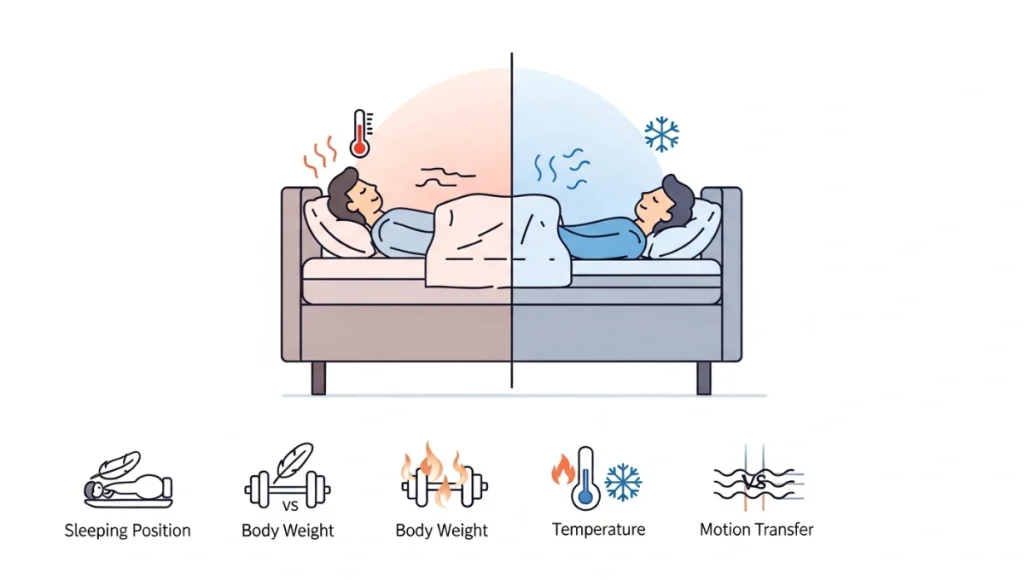
Instead of asking just one person’s preferences, the quiz collects answers from both partners and weighs them together. It factors in things like:
- Sleeping position (side, back, stomach, or combination)
- Body weight and height
- Preferred firmness level
- Motion sensitivity — does your partner’s movement wake you?
- Temperature preferences — do either of you sleep hot?
- Whether you share the bed with children or pets
The result?
A shortlist of mattresses that genuinely suit both of you, not just a compromise that satisfies neither.
Think of it as a structured way to answer a tricky question: how do two people with different sleep styles end up on a mattress they both love?
The answer lies in compatible design.
Instead of endless comparison, you get a personalised recommendation based on real-world compatibility factors — and you can get there in just a few minutes.
A common scenario we see: one partner sleeps hot and wakes easily, while the other changes position all night. In this situation, couples often think firmness is the problem — but motion isolation and cooling tend to make a bigger difference.
With this in mind, our specially designed couples mattress quiz will help you cut through the confusion and find the most suitable options for you based on your answers to our questions.
Choosing the Right Mattress Size for Two Sleepers
Most couples jump straight to firmness and materials. But mattress size is often the bigger factor in shared sleep quality.
Research suggests that mattress size directly affects sleep quality, movement, and even relationship satisfaction — all things that matter when you’re sharing a bed every night.
Interestingly, many couples moving from a double mattress to a queen-size mattress notice better sleep even before changing mattress material — simply because they’re no longer competing for space.
With that in mind, here’s a quick breakdown of the main options and what suits different couples:
Queen vs. King: Which Mattress Size Is Best for Couples?
This is the most common question — and the answer depends on your room, your lifestyle, and how much personal space you both value.
Queen (60″ x 80″) — The most popular choice for couples.
- Great balance of space and practicality
- Fits comfortably in most standard bedrooms
- Works well for average-height couples who don’t spread out excessively
- Usually compatible with existing bed frames
This is a smart starting point for couples upgrading from a smaller bed. The jump in space feels significant, and the room stays manageable.
King (76″ x 80″): Ideal for couples who want maximum personal space.
- Great for tall couples, combination sleepers, or anyone who moves around a lot
- Reduces motion disturbance simply through distance — you’re further apart
- A good option if you share the bed with pets or children
- Requires a larger room and a compatible bed frame
The extra 16 inches of width is meaningful. But bigger only works when the room can handle it — a king mattress that crowds a small bedroom will make the space feel cramped, not comfortable.
| Mattress Size | Best For | Watch Out For |
|---|---|---|
| Queen | Most couples | Can feel tight with pets |
| King | Tall couples & movement | Needs larger room |
| Full/Double | Small spaces | Limited personal space |
Many mattress retailers report that queen-size remains the most purchased size for couples, mainly because it balances comfort and room layout.
Full and Double Mattress Options: When They Still Work for Couples
Full/Double (54″ x 75″) — Best for smaller spaces or shorter sleepers.
- Works in studio apartments, guest rooms, or compact bedrooms
- Less personal space per person than a queen
- A reasonable choice for couples who prefer closeness or won’t be stretching out
For long-term everyday use, though, most couples find that the smaller footprint becomes limiting — especially as circumstances change.
Height, Body Proportions, and Bedroom Layout
Taller sleepers need full leg extension, which means mattress length becomes as important as width.
Both queen and king sizes offer 80 inches of length — enough for most people. But if one or both partners are notably tall (6’3″+ or more), it’s worth checking the exact dimensions before buying.
Bedroom layout matters too. A larger mattress that doesn’t leave walkable space around the frame can make getting in and out of bed awkward — and that affects sleep more than you’d think.
The right size isn’t just about comfort — it’s about fit. Both the physical fit in your room, and the practical fit for how you actually sleep together.
What Couples Really Need Beyond Mattress Size
Size sets the foundation. But the features inside the mattress are what determine whether two people actually sleep well on it.
Here are the key things to look for — and why they matter specifically for couples:
Motion Isolation: The Most Underrated Feature for Couples
If one partner moves frequently during the night, the other one feels it. This is called motion transfer — and it’s one of the most common causes of disrupted sleep for couples.
According to CDC data, around 18% of adults have trouble staying asleep. For couples sharing a bed, a partner’s movements are a major contributing factor.
Good motion isolation — typically found in memory foam and hybrid mattresses — absorbs movement so it doesn’t ripple across the surface.
This is great because it means one partner can shift positions, get up for water, or toss and turn without waking the other.
Our take on this: Most couples overestimate how much firmness matters and underestimate motion isolation. If one partner is a light sleeper, movement control usually matters more than softness vs firmness.
Cooling Features: Essential for Warm Sleepers
Body heat builds up under shared bedding. If either of you tends to sleep warm, a mattress with temperature regulation makes a real difference.
Look for breathable foams, gel infusions, or open-coil hybrid designs that allow air to circulate.
This allows you to experience deeper, uninterrupted sleep — rather than waking because you’re overheating.
Edge Support: More Important Than Most People Realise
Poor edge support means the mattress compresses near the sides, which effectively shrinks your usable sleep surface.
When two people share a bed, this can push both partners toward the centre — reducing space and causing discomfort.
Mattresses with reinforced edges let you use the full surface right to the perimeter. That’s especially helpful if you have pets, or simply like to sleep near the edge.
Firmness and Responsiveness: Finding the Middle Ground
Research backs this up: a systematic review published on PubMed found that a medium-firm mattress is optimal for sleep comfort, quality, and spinal alignment.
For couples, medium to medium-firm tends to work well across the board. It offers enough give for side sleepers while maintaining support for back sleepers.
Responsiveness matters too. A bouncier surface makes it easier to change positions without feeling stuck. Deeper-contouring mattresses reduce movement transfer but can feel restrictive. The right balance depends on what both of you prioritise.
Common Mistakes Couples Make When Choosing a Mattress
Most couples don’t actually choose the wrong mattress — they just focus on the wrong things first. Here are three mistakes that cause unnecessary frustration later.
Choosing firmness before size
Firmness gets most of the attention, but space is often the bigger issue. If you’re running out of room or drifting toward the edge during the night, changing softness won’t fix the problem.
Getting the right size mattress first gives both partners enough room to move comfortably, which often improves sleep immediately before you even factor in feel.
Ignoring motion isolation
Movement transfer is one of the biggest causes of disrupted sleep for couples, yet many people don’t think about it until after they buy.
If one partner moves frequently, a mattress with poor motion isolation can mean both people wake more often. Prioritising motion control early usually makes a bigger difference than small changes in firmness.
Buying based on one partner’s needs
It’s easy to focus on the partner with stronger preferences — whether that’s firmer support, softer cushioning, or cooling features. But a mattress that works brilliantly for one person can quickly become uncomfortable for the other.
The best choice usually balances both sleep styles, rather than optimising for one and hoping the other adapts.
How to Use Your Mattress Quiz Results to Compare Options
Once you’ve completed the quiz, you’ll receive a list of the top three recommended mattresses matched to both partners’ preferences.
This is where the tool becomes genuinely useful.
Instead of browsing hundreds of models and second-guessing every choice, you have a focused starting point — three options that already meet your core criteria.
Each recommendation is selected based on:
- Comfort and support for your combined sleep positions
- Motion isolation based on how sensitive each partner is to movement
- Cooling performance if either of you sleeps warm
- Edge support, firmness, and overall design for two sleepers
A practical tip: open all three results in separate tabs so you can compare them side by side. Look at trial length, materials, warranty, and how the feel matches your preferences.
This side-by-side process helps you identify the option that best balances both partners’ needs — rather than just picking the one with the best headline spec.
Think of the three results as slightly different paths to the same destination: better shared sleep. One might prioritise pressure relief, another edge support, and another overall value.
FAQs: Buying a Mattress for Couples
Are mattress quizzes accurate for couples?
Yes — when well designed, they use key data points like sleep position, motion sensitivity, and body weight to narrow down suitable options. They don’t replace physically trying a mattress, but they provide a strong starting point by filtering out options that are unlikely to suit both partners.
Queen vs. king mattress for couples — which should we choose?
A queen suits most couples because it balances comfort and room space. A king offers extra width for movement and separation — ideal if you sleep with pets or if one partner moves a lot. It comes down to your room size and how much personal space you each want.
Is a queen-size mattress big enough for two people?
For most couples, yes. A queen offers enough room for comfortable sleep if both partners are average height and don’t spread out excessively. If you feel cramped or move frequently during the night, upgrading to a king can help.
What’s the best mattress firmness for couples?
Medium to medium-firm. Research consistently supports this as the optimal range for comfort, support, and spinal alignment — and it tends to work across different sleeping positions, which is key for couples.
Can a mattress quiz help if we have completely different sleep styles?
Absolutely. This is exactly what it’s designed for. The quiz weighs both partners’ answers to find a middle ground — often recommending options with strong motion isolation, zoned support, or multiple firmness options.
How often should couples replace their mattress?
Most mattresses last around 7–10 years. Couples may find their mattress wears slightly faster than single-sleeper use due to combined sleeper weight and movement.
If you’re waking up sore or noticing visible sagging, it’s likely time to replace it regardless of age.
What is the best budget mattress for couples?
There is no one perfect mattress for all couples since requirements differ considerably from couple to couple. That said, there are a number of mattresses that are considered to be excellent for couples for various reasons.
See our recommended budget mattresses guide for a list of the top affordable mattresses suitable for couples.
Finding Your Perfect Match: A Final Word
A mattress quiz for couples doesn’t just simplify the process — it makes it smarter.
Rather than one partner compromising, or both of you wading through page after page of specs, the quiz puts both your preferences into one clear recommendation.
The result is a shortlist of the three best-matched mattresses for your situation. From there, the comparison is easy.
A helpful tip: open all three results in separate tabs, compare trial lengths and materials side by side, and look for the option that balances both partners’ priorities — not just the best individual features.
If you still feel slightly torn between two options — that’s normal. The goal isn’t perfection. It’s narrowing choices to the few that genuinely fit both of you.
Shared sleep shouldn’t mean shared compromise. The right mattress is out there, and our quiz is the fastest way to find it. Most couples spend weeks comparing mattresses. This couples quiz shortens that to about a minute.